
Resource: Free Printable Science Fair Worksheets | Grades: 5–8 | Format: PDF | Subjects: Biology, Chemistry, Physics, Earth Science and Engineering
Science Fair Project Ideas PDF: Free Worksheets and Templates
Planning a science fair project is easier when you have a clear research question, a testable hypothesis and a place to record your results. Our free science fair project worksheets help students in grades 5–8 organize their investigations from the first idea to the final display board.
Download the printable PDF, explore experiment suggestions and follow the planning steps below. The worksheets are designed for classroom assignments, home science projects and school science fairs.
Quick Answer: Where Can I Find a Free Science Fair Project Ideas PDF?You can download a free four-page science fair planning PDF from this page. It includes project ideas, a research question planner, hypothesis and variables worksheet, experiment checklist, results tables, graph planner and conclusion template.
Students can print the worksheets and use them with a teacher-approved experiment. The PDF is intended for planning and recording original work; it does not contain fabricated results.
Download Free Science Fair Worksheets
Grades 5–8 | Four Printable Pages | PDF Format
Plan your experiment, organize your variables, record observations and prepare your science fair presentation.
Download Free Science Fair PDF
No registration required. PDF opens in a compatible browser or PDF reader.
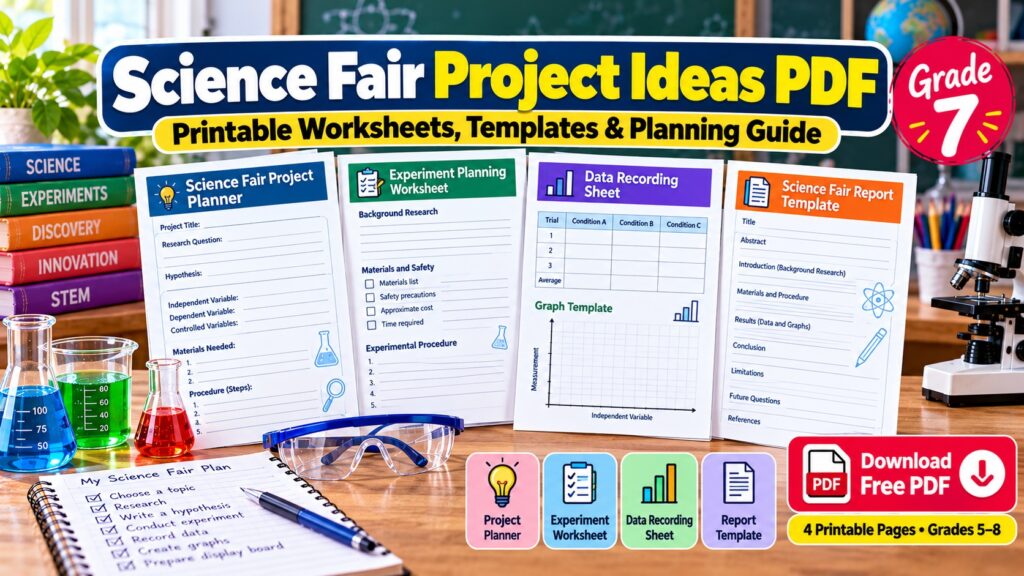
What’s Included in the Free PDF?
| Page | Worksheet | How It Helps |
|---|---|---|
| 1 | Science Fair Project Planner | Choose a question, write a hypothesis and identify variables |
| 2 | Experiment Planning Worksheet | List materials, safety precautions and experimental steps |
| 3 | Observation and Results Sheet | Record repeated trials, measurements and daily observations |
| 4 | Graph, Conclusion and Display Board | Plan a graph, interpret results and organize a presentation |
Six Science Fair Projects to Use With the Worksheets
These six experiment guides offer practical investigations that can be combined with the downloadable planner. Choose a project appropriate for your grade, time available and school safety requirements.
| Science Fair Project | Main Variable | Measurement | Guide |
|---|---|---|---|
| Water Temperature and Sugar Dissolving | Water temperature | Dissolving time | Read guide |
| Which Paper Towel Absorbs the Most Water? | Paper towel brand | Amount of water absorbed | Read guide |
| Does Salt Make Ice Melt Faster? | Salt amount | Ice melting rate | Read guide |
| Which Type of Soil Holds the Most Water? | Soil type | Water retained | Read guide |
| Does Light Color Affect Plant Growth? | Light color | Plant height and leaf growth | Read guide |
| How Does Water pH Affect Seed Germination? | Solution pH | Germination percentage | Read guide |
How to Choose a Good Science Fair Project
A successful school science project begins with a question that can be answered through observation or measurement.
Consider these questions before choosing:
- Can the experiment be completed before the school deadline?
- Are the materials affordable and readily available?
- Can I change one independent variable while controlling other conditions?
- Can I measure the results using a ruler, scale, thermometer, timer or other suitable tool?
- Can I repeat the experiment to check consistency?
- Can I explain the science behind the results?
- Is the project safe and permitted by my teacher?
How to Write a Science Fair Hypothesis
A hypothesis is a testable prediction about what may happen during an experiment.
Hypothesis TemplateIf [independent variable] changes, then [dependent variable] will change because [scientific explanation].
Example: If the temperature of water increases, then a fixed amount of sugar will dissolve faster under otherwise identical conditions because warmer water generally promotes faster dissolving.
A hypothesis is not the same as a conclusion. Write it before collecting results and evaluate it using the measurements you obtain.
Independent, Dependent and Controlled Variables
| Variable | Meaning | Example |
|---|---|---|
| Independent variable | The factor deliberately changed | Water temperature |
| Dependent variable | The result measured | Time for sugar to dissolve |
| Controlled variables | Factors kept consistent | Sugar mass, water volume, stirring method and container |
Controlling variables makes comparisons more meaningful. If several conditions change at once, it may be difficult to identify what caused the observed differences.
How to Record Science Fair Results
Use the downloadable observation sheet to record each trial. Include measurement units and note any unusual observations.
| Trial | Condition A | Condition B | Condition C |
|---|---|---|---|
| 1 | ____ | ____ | ____ |
| 2 | ____ | ____ | ____ |
| 3 | ____ | ____ | ____ |
| Average | ____ | ____ | ____ |
Students should record actual observations. Never substitute predicted values or copy results from another experiment.
How to Make a Science Fair Graph
Graphs make patterns easier to identify.
- Bar graph: Useful for comparing categories, such as paper towel brands or soil types.
- Line graph: Useful for showing changes over time, such as seedling growth across several days.
- Scatter plot: Useful for investigating relationships between numerical variables, such as ramp height and travel distance.
Include a descriptive graph title, labeled axes and correct measurement units. Use an appropriate scale that does not exaggerate the differences.
How to Write a Science Fair Conclusion
Conclusion Writing TemplateMy experiment investigated how _____ affected _____. I predicted that _____. My measurements showed _____. These results supported or did not support my hypothesis because _____. One limitation was _____. If I repeated the experiment, I would improve _____.
It is acceptable for results not to support the hypothesis. Scientific investigations are intended to test ideas, not to guarantee a particular outcome.
Science Fair Display Board Checklist
- Project title and research question
- Background research and scientific references
- Hypothesis
- Independent, dependent and controlled variables
- Materials and experimental procedure
- Safety precautions
- Photographs of the experiment
- Results table and labeled graph
- Conclusion and limitations
- Suggestions for future investigations
Science Fair Resources by Grade
- Easy Science Experiments for 6th Graders
- 100 Science Fair Ideas for 7th Grade
- 35 Science Fair Project Ideas for 7th Grade
Trusted Science Fair References
- Science Buddies — Science Fair Project Guide
- Society for Science — International Science Fair Rules
- USGS — Water Science School
Safety and Teacher ApprovalFollow your school’s science fair rules. Experiments involving people, animals, microorganisms, hazardous substances or specialized equipment may require prior approval. Use adult supervision where appropriate and never drink water from filtration experiments.
Download Your Free Science Fair PDF
Ready to plan your project?
Print the four-page science fair resource pack and use it to organize your research question, hypothesis, procedure, measurements and final presentation.
Get the Free Printable Worksheets
Editorial note: This educational resource provides planning templates and suggested investigations, not pre-completed experiments or guaranteed science fair results. Students must collect and interpret their own data.