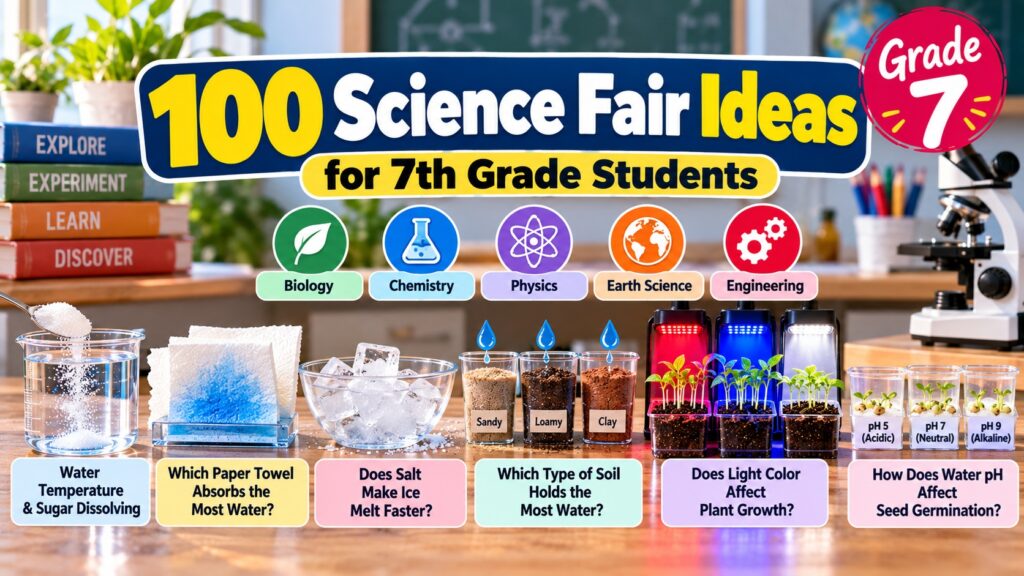

Grade: 7 | Subjects: Biology, Chemistry, Physics, Earth Science and Engineering | Project types: Experiments, Investigations and Designs
100 Science Fair Ideas for 7th Grade Students
Looking for a seventh-grade science fair project that is interesting, affordable and possible to finish before your school deadline? The strongest projects usually begin with one clear question, test one variable, and collect measurable results.
Choose a project that can be repeated safely, measured with simple tools, and explained using a graph. A careful investigation is more valuable than an impressive-looking demonstration without data.
Start Here: Six Complete Science Fair Experiments
These six project guides provide a practical starting point for students who want more than a list of titles.
| Project | Subject | What You Measure | Detailed Guide |
|---|---|---|---|
| Water temperature and sugar dissolving | Chemistry | Dissolving time | Read experiment |
| Which paper towel absorbs most? | Materials Science | Water absorbed | Read experiment |
| Does salt melt ice faster? | Chemistry | Ice melting time | Read experiment |
| Which soil holds the most water? | Earth Science | Water retained | Read experiment |
| Does light color affect plant growth? | Biology | Plant height and leaf growth | Read experiment |
| How does water pH affect seed germination? | Biology | Germination percentage | Read experiment |
If a recently published guide uses a different permalink, update its link before saving this article.
Browse 100 Science Fair Project Ideas by Subject
Chemistry
Biology
Earth Science
Engineering
Math
Energy
Materials
Environment
Everyday Science
1. Physics Science Fair Ideas
Physics projects explore motion, forces, energy and sound. These investigations work especially well when students can take several measurements and calculate averages.
- How does ramp height affect the distance a toy car travels?
- Which paper airplane design travels the farthest?
- Does pendulum length affect swing time?
- How does surface texture affect friction?
- Does ball inflation pressure affect bounce height?
- Which surface makes a marble roll farthest?
- How does parachute size affect falling time?
- Does string tension change the pitch of a string instrument?
- How does the mass of a toy car affect its stopping distance?
- Does the angle of a ramp affect rolling time?
2. Chemistry Science Fair Ideas
Use household materials, teacher-approved procedures and appropriate safety precautions. Avoid concentrated chemicals and uncontrolled reactions.
- How does water temperature affect sugar dissolving time?
- Does salt change how quickly ice melts?
- Which type of sugar dissolves fastest?
- How does stirring affect dissolving time?
- Which beverage is most acidic according to pH strips?
- How does temperature affect salt crystal formation?
- Does the amount of salt affect how much an egg floats?
- Which household liquid produces the strongest red cabbage indicator color change?
- How does water temperature affect food coloring diffusion?
- Does particle size affect how quickly a sugar cube dissolves?
3. Biology and Plant Science Ideas
Plant experiments are often affordable and provide measurable changes over several days. Use the same seed variety, light conditions and watering schedule unless one is the variable being tested.
- Does light color affect plant growth?
- How does water pH affect radish seed germination?
- Does seed planting depth affect sprouting time?
- How does water temperature affect seed germination?
- Does the amount of water affect seedling height?
- How does soil type affect bean plant growth?
- Does light duration affect seedling growth?
- Do different seed varieties germinate at different rates?
- Does seed soaking time affect germination?
- How does mild salt concentration affect seed germination?
4. Earth and Soil Science Ideas
- Which type of soil holds the most water?
- How does ground slope affect soil erosion?
- Does mulch reduce soil water evaporation?
- Which soil type drains water fastest?
- How does soil compaction affect water infiltration?
- Does vegetation cover reduce soil erosion?
- Which soil sample contains the largest visible particles?
- How does shade affect soil temperature?
- Do different ground surfaces heat at different rates?
- How does soil moisture affect soil temperature changes?
5. Engineering and Design Projects
Engineering projects use a different process from experiments: define a problem, build a prototype, test it, and improve the design.
- Which paper bridge design holds the most weight?
- What tower base shape creates the most stable structure?
- Which parachute design has the slowest descent?
- Which model boat shape supports the most weight?
- How does bridge span length affect load capacity?
- Which recycled material makes the strongest model beam?
- How can a cardboard ramp be designed for consistent toy car speed?
- Which paper helicopter design falls most slowly?
- How does the shape of a wind turbine blade affect rotation speed?
- Which packaging design best protects a fragile object from a short drop?
6. Math and Data Science Projects
- How accurate are estimates of one minute without a clock?
- Which coin-flipping sample size gets closest to a 50–50 result?
- How does sample size affect the stability of an average?
- Do different dice produce similar frequency distributions?
- How accurately can people estimate the number of objects in a jar?
- Does graph scale change how people interpret the same data?
- How does the number of trials affect experimental reliability?
- Which method of measuring an irregular shape gives the most consistent area estimate?
- How closely do paper airplane flight distances follow a normal-looking distribution?
- Can a simple mathematical model predict toy car travel distance?
7. Energy and Temperature Experiments
- Which insulating material keeps water warm longest?
- Does container color affect how quickly water warms in sunlight?
- How does cup material affect heat loss?
- Which reflective material reduces radiant heating most?
- Does lid design affect cooling rate?
- How does surface area affect water evaporation?
- Does airflow affect drying time?
- Which solar oven reflector design reaches the highest temperature?
- How does shade cloth affect surface temperature?
- Does container shape affect the cooling rate of water?
8. Materials Science Experiments
- Which paper towel brand absorbs the most water?
- Which fabric absorbs water fastest?
- How does paper thickness affect tear resistance?
- Which adhesive holds paper strips together most strongly?
- Does folding paper increase its ability to support weight?
- Which sponge material retains the most water?
- Does fabric weave affect drying time?
- How does cardboard layering affect bending strength?
- Which reusable cloth dries fastest after washing?
- How does material texture affect water droplet spreading?
9. Environmental Science Ideas
- Which filter material removes the most visible particles from muddy water?
- How does vegetation affect rainwater runoff in a model landscape?
- Which ground cover reduces evaporation most effectively?
- Does surface color affect heat absorption?
- How does rainfall intensity affect erosion in a soil tray?
- Which reusable container keeps drinks cold longest?
- How does water turbidity affect light transmission?
- Does the size of gravel affect water filtration speed?
- Which natural material absorbs a simulated oil spill best?
- How does the thickness of mulch affect soil moisture retention?
Water filtered in a school experiment is not necessarily safe to drink. Never consume test water.
10. Easy Science Fair Ideas Using Household Materials
- Does water temperature affect how fast ice cubes melt?
- Which paper airplane fold is most accurate at hitting a target?
- How does the amount of dish soap affect bubble lifetime?
- Does bubble wand shape affect bubble size?
- Which towel material dries a wet surface fastest?
- How does water depth affect the time an object takes to sink?
- Which type of cup prevents condensation from reaching a tabletop?
- Does stirring speed affect how quickly cocoa powder mixes into water?
- How does the size of a paper parachute affect descent time?
- Which wrapping material best prevents an ice cube from melting?
Which Science Fair Project Should You Choose?
| Your Priority | Suggested Project | Why It Fits |
|---|---|---|
| Finish in one day | Paper towel absorption | Easy measurements and repeatable trials |
| Use a graph | Ramp height and toy car distance | Clear numerical data |
| Explore biology | Water pH and seed germination | Observe living systems over time |
| Build something | Paper bridge strength | Design, test and improve |
| Study the environment | Soil water retention | Connects to agriculture and water conservation |
| Use inexpensive supplies | Salt and ice melting | Common materials and simple comparisons |
How to Turn an Idea Into a Real Science Fair Experiment
Step 1: Ask a Testable Question
Instead of asking “Which soil is best?”, ask “Which soil type retains the most water after adding the same volume?” The second question identifies something measurable.
Step 2: Write a Hypothesis
Use the format: If [independent variable changes], then [dependent variable will change] because [scientific explanation].
Step 3: Identify the Variables
- Independent variable: What you deliberately change
- Dependent variable: What you measure
- Controlled variables: What stays the same
Step 4: Repeat the Test
Run multiple trials under consistent conditions. Repeated trials help show whether a result is consistent or was affected by chance or measurement error.
Step 5: Record Your Own Results
Use a notebook or spreadsheet. Do not fill in expected results as though they were observed.
| Trial | Condition A | Condition B | Condition C |
|---|---|---|---|
| 1 | ____ | ____ | ____ |
| 2 | ____ | ____ | ____ |
| 3 | ____ | ____ | ____ |
| Average | ____ | ____ | ____ |
Step 6: Make a Graph
Choose a bar graph to compare categories or a line graph to show changes over time. Label both axes and include measurement units.
Step 7: Explain the Conclusion
State whether your measurements support the hypothesis, describe unexpected findings, identify limitations and suggest how to improve the experiment.
Science Fair Display Board Layout
- Project title and research question
- Background research
- Hypothesis
- Materials and safety precautions
- Variables and experimental procedure
- Photographs and observations
- Data tables and graphs
- Results and conclusion
- Limitations and references
Common Mistakes to Avoid
- Changing multiple variables at the same time without a clear design
- Testing only once and treating the result as conclusive
- Using too few samples to see meaningful differences
- Copying results from another project
- Choosing a demonstration with no measurable research question
- Forgetting units on graphs
- Ignoring unexpected observations
How Long Does a 7th Grade Science Fair Project Take?
A simple physical science experiment may be completed in one afternoon, while plant investigations often need one or two weeks. Allow additional time for research, repeated trials, graphs and the final presentation.
Start by checking your school’s deadline and any required approval forms. Choose an experiment that can be completed comfortably before the submission date.
Helpful Science Fair Resources
- Science Buddies — Science Fair Project Guide
- Society for Science — International Science Fair Rules
- USGS — Water Science School
Final Advice for 7th Grade Students
The best science fair project is one you can investigate carefully. Select a question that interests you, plan a fair test, record real measurements and explain what your evidence shows.
Whether you choose plants, motion, water, materials or engineering, clear methods and thoughtful analysis make your project more meaningful.
Editorial note: These are suggested investigation topics, not claims of completed experiments or guaranteed competition results. Students should follow teacher instructions and document their own findings.

Pingback: Water Temperature and Sugar Dissolving Experiment
Pingback: Does Salt Make Ice Melt Faster? Science Fair Experiment