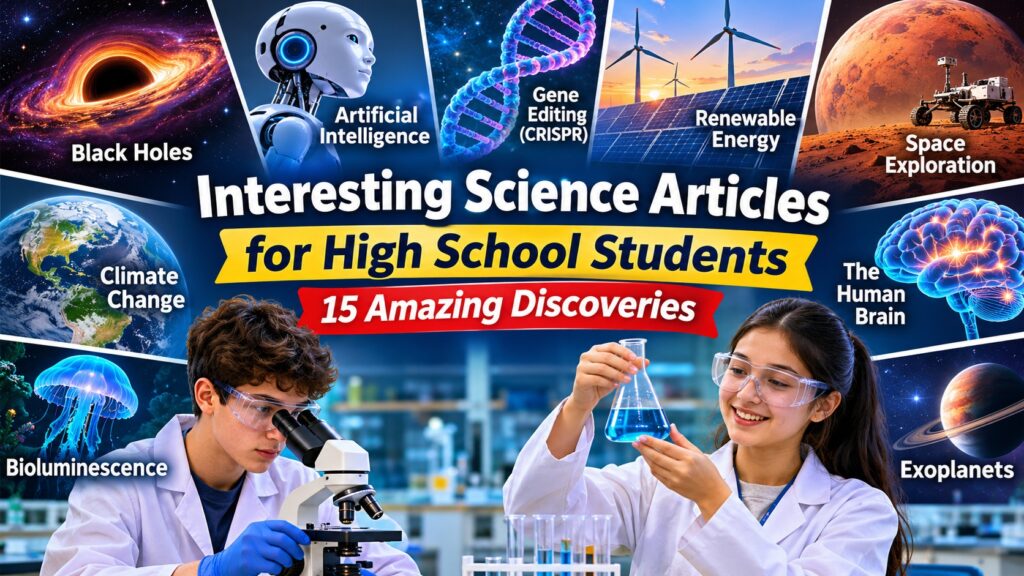

15 Interesting Science Articles for High School Students
Science is more than memorizing formulas or preparing for exams. It is about asking questions, testing ideas, and discovering how the world works. From distant planets to microscopic DNA, modern science offers exciting subjects that students in grades 9–12 can explore.
This collection introduces 15 fascinating science topics, explains why they matter, and suggests practical ways to investigate them. Whether you enjoy biology, chemistry, physics, astronomy, or computer science, you can find an idea worth exploring.
15 Fascinating Science Topics at a Glance
| Science Topic | Subject | Student Activity |
|---|---|---|
| Artificial Intelligence | Computer Science | Compare AI predictions |
| Black Holes | Physics | Model gravity |
| CRISPR Gene Editing | Biology | Model DNA sequences |
| Renewable Energy | Environmental Science | Test solar panels |
| Quantum Physics | Physics | Explore light spectra |
| Exoplanets | Astronomy | Model planetary transits |
| Microplastics | Environmental Science | Compare filtration methods |
| Human Brain | Neuroscience | Measure reaction times |
| Robotics | Engineering | Build a simple robot |
| Climate Change | Earth Science | Analyze temperature data |
| Bioluminescence | Biology | Study light-producing organisms |
| 3D Printing | Engineering | Test printed structures |
| Ocean Acidification | Chemistry | Study pH changes |
| Space Exploration | Astronomy | Design a Mars habitat |
| Smart Materials | Materials Science | Investigate shape-memory materials |
1. How Is Artificial Intelligence Changing Science?
Artificial intelligence allows computers to identify patterns in data and perform tasks that ordinarily require human reasoning or perception. Scientists use machine learning to analyze medical images, study weather patterns, and examine enormous collections of astronomical observations.
However, AI predictions are not always correct. Their reliability depends on training data, testing methods, and the situations in which they are used.
Student investigation: Compare the accuracy of a simple image-classification model when trained with balanced and unbalanced examples.
2. What Happens Inside a Black Hole?
A black hole is a region of spacetime where gravity is so strong that light cannot escape from within its event horizon. Many black holes form when massive stars collapse at the end of their lives.
Although black holes cannot be observed directly through light emitted from inside their event horizons, astronomers can study their effects on surrounding matter and nearby stars.
Student investigation: Use a stretched fabric model to illustrate how mass affects the motion of nearby objects. Explain the limitations of this analogy.
Also Read : JAMB Data Error Candidates Cleared
3. Can Scientists Edit Human DNA?
CRISPR-Cas9 is a gene-editing technology that enables researchers to make targeted changes to DNA. It developed from research into natural defense systems found in bacteria.
Gene editing has important applications in biomedical research and some medical treatments. It also raises ethical questions about safety, access, and the consequences of altering genetic information.
Student investigation: Build a paper model of a DNA sequence and demonstrate how a targeted change could alter genetic instructions.
Read more through the NIH genetics education resources.
4. Can Renewable Energy Replace Fossil Fuels?
Solar panels convert sunlight into electricity, while wind turbines convert the kinetic energy of moving air into electrical energy. These technologies can reduce dependence on fossil fuels.
One challenge is that sunlight and wind vary over time. Energy storage, electricity grids, and a combination of energy sources help address this problem.
Student investigation: Measure the voltage or power output of a small solar panel at different angles under consistent lighting conditions.
5. Why Is Quantum Physics So Strange?
Quantum physics describes the behavior of matter and energy at extremely small scales. Electrons, photons, and other quantum systems behave in ways that classical physics cannot fully explain.
Quantum theory is essential to understanding semiconductors, lasers, and many modern electronic technologies.
Student investigation: Explore atomic emission spectra using a classroom spectroscope and teacher-approved light sources.
6. Are There Planets Similar to Earth?
Exoplanets are planets orbiting stars outside our solar system. Astronomers have discovered thousands of them using techniques such as the transit method, which detects small changes in a star’s brightness.
The James Webb Space Telescope also helps scientists study the atmospheres of certain distant planets. Discovering a planet in a potentially habitable zone does not prove that life exists there.
Student investigation: Move a small ball in front of a lamp and measure the change in light using a suitable light sensor.
Explore NASA’s exoplanet learning activities.
7. Why Are Microplastics Found in the Environment?
Microplastics are small plastic particles, generally less than five millimeters across. They can form when larger plastic products break apart or originate from products and industrial processes.
Researchers investigate how these particles move through rivers, oceans, soil, and food webs. Their effects depend on particle characteristics, exposure, and environmental conditions.
Student investigation: Compare how different filter materials capture visible particles used as safe substitutes for microplastics. Do not release plastic particles into drains or waterways.
8. How Does the Human Brain Process Information?
The human brain contains networks of neurons that communicate through electrical and chemical signals. These networks help regulate movement, memory, perception, and decision-making.
Scientists study how attention, practice, sleep, and other factors influence learning and performance.
Student investigation: Conduct a simple ruler-drop reaction-time experiment with volunteers and compare repeated measurements.
9. How Do Robots Sense Their Surroundings?
Robots combine mechanical structures, electronics, sensors, and computer programs to perform tasks. Some robots operate in factories, while others explore dangerous environments or assist researchers.
A robot can use sensors to detect distance, light, temperature, or motion and then respond according to programmed instructions.
Student investigation: Build a small obstacle-avoiding robot or simulate one using a beginner-friendly robotics platform.
10. What Evidence Shows Earth’s Climate Is Changing?
Scientists examine temperature records, atmospheric greenhouse gas concentrations, glaciers, ocean heat, and other indicators to understand climate change.
Greenhouse gases absorb and emit infrared radiation, influencing Earth’s energy balance. Human activities have increased atmospheric concentrations of several important greenhouse gases.
Student investigation: Graph historical temperature measurements from an authoritative scientific dataset and distinguish long-term trends from year-to-year variation.
11. Why Do Some Living Organisms Glow?
Bioluminescence is light produced through chemical reactions inside living organisms. Fireflies, some fungi, and numerous marine organisms use this remarkable ability.
Bioluminescence can serve functions such as communication, attracting prey, camouflage, or defense.
Student investigation: Research the chemical reactions involved and compare bioluminescence with fluorescence using safe classroom demonstrations.
12. Can 3D Printing Transform Engineering?
Three-dimensional printing, also called additive manufacturing, builds objects from digital designs, often by depositing material layer by layer.
Engineers use 3D printing for prototypes, custom components, and complex structures that may be difficult to manufacture through conventional methods.
Student investigation: Design two different bridge structures using CAD software and compare their predicted strength-to-weight ratios. Print and test them if supervised equipment is available.
13. Why Is the Ocean Becoming More Acidic?
Seawater absorbs carbon dioxide from the atmosphere. Dissolved carbon dioxide participates in chemical reactions that can lower ocean pH and reduce the availability of carbonate ions used by many shell-building organisms.
Ocean acidification does not mean that the entire ocean has become acidic; seawater remains generally alkaline, but its pH has declined.
Student investigation: Use safe pH indicators to compare ordinary water and carbonated water. Explain why this demonstration is not an exact model of seawater chemistry.
Learn more from NOAA’s high school ocean acidification lessons.
14. Could Humans Live on Mars?
Mars presents major challenges for human settlement, including a thin atmosphere, low temperatures, radiation exposure, and limited readily available resources.
Scientists and engineers investigate habitat design, water recovery, food production, and technologies that could use local materials.
Student investigation: Design a model Mars habitat and calculate its estimated energy, water, and living-space requirements for a small crew.
15. What Are Smart Materials?
Smart materials respond to changes in their surroundings. Some change shape when heated, while others alter their electrical or optical properties in response to external conditions.
Shape-memory alloys, for example, can recover a previously established shape under suitable temperature conditions.
Student investigation: Research a commercial shape-memory alloy and create a diagram explaining its behavior. Any heating demonstration should be conducted under teacher supervision.
Which Science Topic Is Best for Your Grade?
| Grade | Suggested Topics |
|---|---|
| Grade 9 | Solar energy, reaction time, bioluminescence |
| Grade 10 | Robotics, microplastics, climate data |
| Grade 11 | Exoplanets, ocean acidification, gene editing |
| Grade 12 | Quantum physics, machine learning, advanced engineering |
How to Turn a Science Article into a Science Fair Project
- Choose a question: Select a topic that can be investigated with available equipment, data, and time.
- Research the science: Read reliable scientific and educational sources before developing a hypothesis.
- Identify variables: Decide what you will change, what you will measure, and what must remain constant.
- Plan a safe method: Obtain teacher approval for activities involving chemicals, electricity, heat, biological materials, or human participants.
- Collect evidence: Record measurements systematically and repeat trials when appropriate.
- Analyze the results: Create graphs, compare observations, and consider possible sources of error.
- Present your findings: Explain what your results support, what they do not prove, and how the experiment could be improved.
Explore additional hands-on ideas in our science fair projects collection.
Reliable Science Resources for Students
- NASA Science — astronomy, planetary science, and space exploration.
- NOAA Education — climate, oceans, and Earth science.
- NIH Science Education — genetics, biology, and biomedical science.
- U.S. Department of Energy Office of Science — physics, energy, and scientific research.
Final Thoughts
The best science articles do more than present surprising facts. They encourage students to ask meaningful questions and investigate evidence.
High school students can begin with accessible experiments involving solar panels, reaction times, or water chemistry before progressing to subjects such as exoplanets, artificial intelligence, and molecular biology.
Whatever subject you choose, curiosity, careful observation, and critical thinking are the foundations of good scientific research.
Editorial note: This educational overview is intended for grades 9–12. Scientific explanations and suggested activities should be reviewed by a teacher when used in classroom experiments. Source organizations include NASA, NOAA, and NIH.

Pingback: 100 Science Fair Project Ideas (Printable PDF Guide) - All Grades