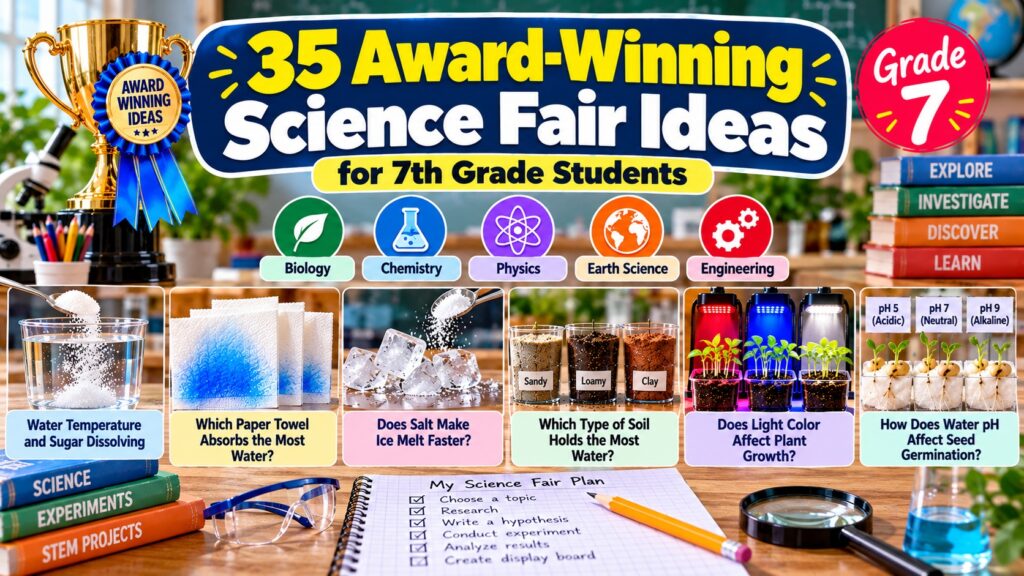

35 Science Fair Project Ideas for 7th Grade Students
Choosing a seventh-grade science fair project can be challenging. Students need a question that is interesting, testable, affordable and appropriate for their available time.
The 35 project ideas below focus on measurable investigations rather than demonstrations alone. Each includes a research question, the main variable to change, what to measure, and an estimated completion time.
Good seventh-grade science fair projects include testing paper towel absorption, salt and ice melting, seed germination, soil water retention, toy car motion, paper bridge strength, water temperature and dissolving time, and thermal insulation.
The strongest choice is a project students can repeat safely, measure accurately and explain with their own data. A clear hypothesis, controlled variables and multiple trials matter more than a complicated-looking setup.
Quick Comparison: 10 Recommended Projects
| Project | Difficulty | Estimated Time | What to Measure |
|---|---|---|---|
| Paper towel absorption | Easy | 1–2 hours | Water absorbed |
| Salt and ice melting | Easy | 1–2 hours | Melting time |
| Sugar dissolving | Easy | 1–2 hours | Dissolving time |
| Soil water retention | Easy | 1–2 days | Water retained |
| Water pH and germination | Moderate | 7–10 days | Germination percentage |
| Light color and plant growth | Moderate | 2–3 weeks | Plant height and leaf count |
| Ramp height and toy car | Easy | 1–2 hours | Travel distance |
| Paper bridge strength | Easy | 2–4 hours | Maximum supported load |
| Insulation materials | Easy | 2–3 hours | Temperature change |
| Mulch and evaporation | Moderate | 5–7 days | Water mass lost |
These times are approximate and exclude research, teacher approval, report writing and display-board preparation.
Biology and Plant Science Projects
1. Does Light Color Affect Plant Growth?
Research question: Do plants grown under different light colors develop differently?
Change: Light color. Measure: Height, leaf number and growth over time.
2. How Does Water pH Affect Seed Germination?
Research question: Do radish seeds germinate at different rates in acidic, near-neutral and alkaline solutions?
Change: Measured solution pH. Measure: Germination percentage and root length.
Note that ingredients used to change pH can introduce additional chemical differences.
3. Does Planting Depth Affect Seed Germination?
Research question: Do seeds planted at different depths emerge at different rates?
Change: Planting depth. Measure: Days until emergence and percentage of seedlings emerging.
4. Does Seed Soaking Time Affect Germination?
Research question: Does soaking seeds for different periods before planting change germination?
Change: Soaking duration. Measure: Number of seeds germinated after a fixed period.
5. Does Water Quantity Affect Seedling Growth?
Research question: How do different watering volumes affect young plants?
Change: Water volume. Measure: Plant height and leaf count.
6. How Does Salt Concentration Affect Seed Germination?
Research question: Do increasing amounts of dissolved salt change germination percentage?
Change: Salt concentration. Measure: Germination percentage.
7. Does Soil Type Affect Plant Growth?
Research question: Do identical seeds grow differently in sandy, loamy and clay-rich soils?
Change: Soil type. Measure: Seedling height and leaf count.
Chemistry and Water Experiments
8. Does Water Temperature Affect Sugar Dissolving?
Research question: How does water temperature change the time needed for sugar to dissolve?
Change: Water temperature. Measure: Dissolving time.
9. Does Salt Make Ice Melt Faster?
Research question: How does adding different amounts of salt affect ice melting under controlled conditions?
Change: Salt amount. Measure: Ice mass remaining after a fixed time or melting time.
10. Does Stirring Speed Affect Dissolving Time?
Research question: Does faster stirring reduce the time required to dissolve a fixed quantity of sugar?
Change: Stirring rate. Measure: Dissolving time.
11. Which Household Liquid Has the Lowest pH?
Research question: How do the measured pH values of several safe household liquids compare?
Change: Liquid type. Measure: pH using test strips.
This is primarily a comparative investigation. Do not taste the test samples or mix cleaning chemicals.
12. How Does Temperature Affect Food Coloring Diffusion?
Research question: Does food coloring spread through water at different rates depending on temperature?
Change: Water temperature. Measure: Time taken for color to spread a defined distance.
13. Does Salt Concentration Affect Floating?
Research question: How does dissolved salt change how high a sealed floating object sits in water?
Change: Salt concentration. Measure: Height of the object above the waterline.
14. Does Sugar Particle Size Affect Dissolving Time?
Research question: Do granulated sugar and larger sugar crystals dissolve at different rates?
Change: Particle size. Measure: Dissolving time using equal sugar masses.
Physics and Motion Experiments
15. How Does Ramp Height Affect Toy Car Travel Distance?
Research question: Does releasing a toy car from a higher ramp position increase its travel distance?
Change: Ramp release height. Measure: Distance traveled after leaving the ramp.
16. Does Pendulum Length Affect Swing Period?
Research question: How does string length affect the time for a pendulum to complete a swing?
Change: Pendulum length. Measure: Time for 10 complete oscillations.
17. Which Surface Creates the Most Friction?
Research question: How does surface material affect the force needed to move the same object?
Change: Surface type. Measure: Pulling force with a spring scale.
18. Does Ball Inflation Affect Bounce Height?
Research question: How does inflation pressure affect the rebound height of a ball?
Change: Ball pressure within manufacturer-approved limits. Measure: Bounce height.
19. Which Paper Airplane Design Flies Farthest?
Research question: How does folding design affect paper airplane flight distance?
Change: Airplane design. Measure: Flight distance across repeated throws.
20. How Does Parachute Area Affect Descent Time?
Research question: Do larger parachutes take longer to descend from the same height?
Change: Parachute area. Measure: Descent time.
21. Does Surface Type Affect Toy Car Stopping Distance?
Research question: Does a toy car travel farther on smooth tile, cardboard or fabric?
Change: Surface type. Measure: Distance traveled from the same ramp setup.
Engineering and Materials Projects
22. Which Paper Towel Brand Absorbs the Most Water?
Research question: How much water can equal-sized samples of different paper towels absorb?
Change: Paper towel brand. Measure: Water absorbed per sample.
23. Which Paper Bridge Design Holds the Most Weight?
Research question: Which folded paper bridge design supports the greatest load?
Change: Bridge design. Measure: Maximum supported mass.
24. Which Insulation Material Keeps Water Warm Longest?
Research question: How do cotton, bubble wrap and felt affect the cooling rate of water?
Change: Insulation material. Measure: Water temperature over time.
Use warm rather than boiling water, with adult supervision.
25. Which Model Boat Design Supports the Most Weight?
Research question: Which boat shape supports the largest load before sinking?
Change: Hull design. Measure: Maximum supported mass.
26. Does Cardboard Layering Increase Strength?
Research question: How does the number of cardboard layers affect resistance to bending?
Change: Layer count. Measure: Deflection under an equal load.
27. Which Fabric Absorbs Water Fastest?
Research question: Do cotton, polyester and microfiber absorb water at different rates?
Change: Fabric type. Measure: Absorbed water mass after a fixed time.
28. Which Packaging Material Protects a Fragile Object Best?
Research question: Which cushioning material reduces damage during a controlled drop?
Change: Packaging material. Measure: Damage score or deformation of a reusable model object.
Earth and Environmental Science Projects
29. Which Type of Soil Holds the Most Water?
Research question: Do sandy, loamy and clay-rich soils retain different quantities of water?
Change: Soil type. Measure: Water retained after drainage.
30. Does Mulch Reduce Soil Water Evaporation?
Research question: Do different mulch materials reduce water loss from soil?
Change: Mulch material. Measure: Container mass lost over time.
31. How Does Ground Slope Affect Soil Erosion?
Research question: Does increasing slope angle increase the amount of soil washed away by simulated rainfall?
Change: Slope angle. Measure: Sediment collected.
32. Which Soil Type Drains Water Fastest?
Research question: How quickly does water pass through equal volumes of different soil types?
Change: Soil type. Measure: Drainage time and water volume collected.
33. Does Surface Color Affect Temperature?
Research question: Do black, white and reflective surfaces warm at different rates under the same lamp?
Change: Surface color or finish. Measure: Surface temperature.
34. Which Filter Material Removes Visible Sediment Best?
Research question: How do gravel, sand and coffee filters compare in removing visible particles from muddy water?
Change: Filter material. Measure: Turbidity using a consistent visual or light-transmission method.
Filtered experimental water must never be considered safe to drink.
35. Does Vegetation Cover Reduce Soil Runoff?
Research question: Does covering soil with grass or plant material reduce sediment loss during simulated rainfall?
Change: Ground cover. Measure: Sediment collected in runoff.
How to Choose a Project That Stands Out
A strong science fair investigation does not need expensive equipment. It needs a focused research question, a fair test, repeatable methods and evidence-based conclusions.
- Can I clearly identify the independent variable?
- Can I measure the dependent variable with available tools?
- Can I complete at least three trials or use replicate samples?
- Can I keep important conditions consistent?
- Can I finish before the school deadline?
- Can I explain the scientific principle behind the experiment?
- Can I perform the project safely and within school rules?
How to Write a Seventh-Grade Science Fair Hypothesis
A hypothesis is a testable prediction based on background research.
Example: “If the thickness of insulation around a cup increases, then the water inside will cool more slowly because thicker insulation can reduce the rate of heat transfer.”
Students should not change the hypothesis after observing the results. Unexpected results are part of scientific investigation.
How to Organize Variables and Data
| Element | Example: Paper Bridge Experiment |
|---|---|
| Independent variable | Bridge folding design |
| Dependent variable | Maximum mass supported |
| Controlled variables | Paper type, paper dimensions, bridge span and loading method |
| Trials | At least three tests for each design |
| Graph | Bar chart comparing average maximum load |
Blank Results Table for Your Science Fair Project
| Trial | Condition A | Condition B | Condition C |
|---|---|---|---|
| 1 | ____ | ____ | ____ |
| 2 | ____ | ____ | ____ |
| 3 | ____ | ____ | ____ |
| Average | ____ | ____ | ____ |
Include the correct measurement units in your actual results table. Record real observations rather than predicted or copied numbers.
How to Write a Science Fair Conclusion
“My investigation tested how _____ affected _____. I predicted that _____. The measurements showed that _____. The average result for the first condition was _____, compared with _____ for the second condition. These findings [supported/did not support] my hypothesis. A limitation of the experiment was _____. If I repeated the investigation, I would improve _____.”
Science Fair Display Board Checklist
- Clear project title and research question
- Background research with references
- Hypothesis
- Independent, dependent and controlled variables
- Materials and experimental procedure
- Photographs of the setup
- Data tables and labeled graphs
- Results and scientific explanation
- Conclusion and limitations
- Ideas for future experiments
What Makes a Science Fair Project Competitive?
Judging criteria vary by school and competition, but projects are commonly evaluated on scientific reasoning, experimental design, evidence, analysis, originality and communication.
A carefully repeated experiment with honest results can be stronger than a complicated project with poorly controlled variables. Do not invent results or claim a project has won an award unless that achievement can be documented.
Students should obtain teacher approval before starting. Avoid culturing unknown microorganisms, experimenting on people or animals without appropriate approval, and using hazardous chemicals, open flames or high-voltage equipment. Use adult supervision when handling warm water, tools or electrical components.
More Science Fair Ideas and Resources
- 100 Science Fair Ideas for 7th Grade
- Science Fair Project Ideas PDF
- Easy Science Experiments for 6th Graders
- Science Buddies — Science Fair Project Guide
- Society for Science — International Rules
Final Recommendation
For a seventh-grade science fair, begin with a project you can measure reliably and explain clearly. Paper towel absorption, soil water retention, ice melting and toy car motion are accessible starting points. Students who have more time can investigate plant growth or seed germination.
Whichever project you choose, use repeated trials, honest measurements and a thoughtful conclusion.


Pingback: How to Fix Error Code N99999 (99999) - Definitive Expert Guide