
Subject: Earth and Environmental Science | Grades: 5–8 | Time: 60–90 minutes plus drying time | Difficulty: Easy
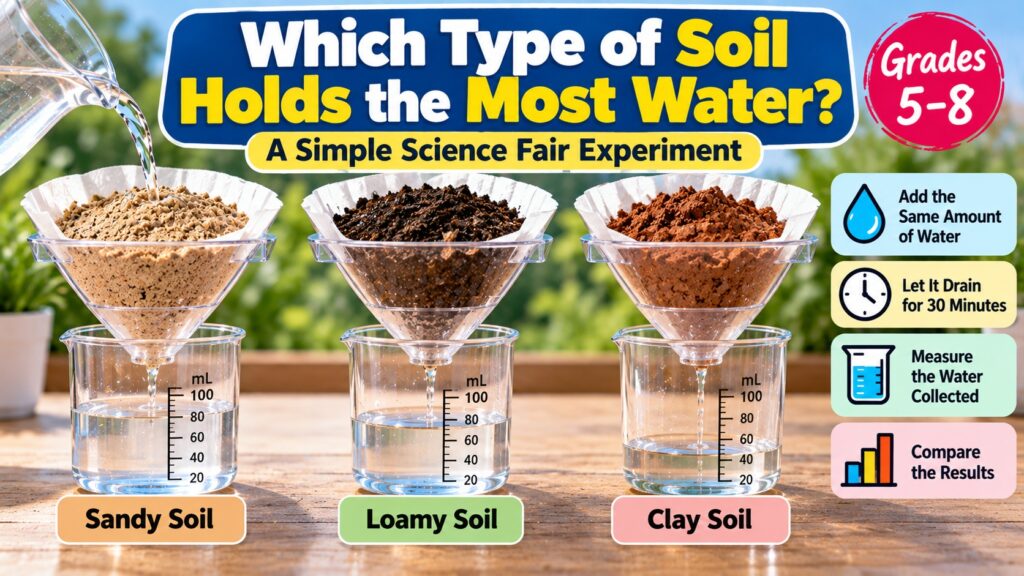
Which Type of Soil Holds the Most Water? Science Experiment
Why does sandy soil dry quickly while some garden soils remain moist for much longer? The answer involves soil texture, particle size, and the spaces between soil particles.
In this science fair experiment, students compare sand, loam, and clay-rich soil to investigate which retains the most water after drainage. This project is suitable for middle school science fairs in the United States and Canada.
However, actual results depend on soil composition, organic matter, compaction, and experimental conditions. Students can test this by adding equal amounts of water to equal dry masses of soil, allowing drainage, and measuring how much water remains.
What Is the Aim of This Experiment?
The aim is to compare the water retention of three soil types: sand, loam, and clay-rich soil.
Students will learn how to design a fair test, measure water retention, calculate averages, and explain why different soils behave differently.
Science Fair Research Question
Which soil type retains the greatest amount of water after equal masses of dry soil receive the same amount of water and drain for the same length of time?
Hypothesis
This is a prediction. Students should record actual measurements rather than assuming the hypothesis is correct.
Materials Required
- Clean sand, loam, and clay-rich soil samples
- Nine identical funnels
- Nine identical coffee filters
- Nine graduated collection containers
- Digital kitchen scale
- Measuring cylinder or measuring cup
- Water
- Labels and marker
- Timer
- Notebook and pencil
- Gloves and protective covering for the work area
Using nine funnels allows three trials for each soil type to be conducted under similar conditions. If fewer funnels are available, clean and dry the equipment between tests.
What Are the Variables?
| Variable | Explanation |
|---|---|
| Independent variable | Soil type: sand, loam, or clay-rich soil |
| Dependent variable | Estimated water retained after drainage, measured in milliliters |
| Controlled variables | Dry soil mass, initial water volume, funnel and filter type, drainage time, water temperature, and preparation method |
Step-by-Step Soil Water Retention Experiment
Step 1: Prepare the Soil Samples
Obtain samples of sand, loam, and clay-rich soil.
Allow the samples to air-dry completely in a clean, ventilated area. Break apart large clumps gently without crushing individual soil particles.
Remove stones, roots, and large debris.
Use the same drying procedure for every soil type. Air-drying may leave some residual moisture, so this classroom method provides an approximate comparison rather than a laboratory-standard measurement.
Step 2: Measure Equal Soil Masses
Use a digital scale to prepare three 50-gram portions of each soil type.
You should have nine soil samples in total.
Label them Sand 1–3, Loam 1–3, and Clay 1–3.
Step 3: Prepare the Funnels
Place identical coffee filters inside nine identical funnels.
Position each funnel above a graduated collection container.
Before adding soil, test a spare filter with water to ensure it drains freely. A filter that is clogged or poorly seated can distort the results.
Step 4: Add the Soil
Place one 50-gram soil sample inside each filter-lined funnel.
Distribute the soil evenly without pressing it down. Compaction can change drainage and water retention.
Step 5: Add Water
Measure 100 mL of room-temperature water for each funnel.
Pour the water slowly and evenly onto the soil over approximately 30 seconds.
Start the timer when pouring begins. Use the same pouring method for every sample.
If water overflows or runs around the filter instead of passing through the soil, repeat that trial with a corrected setup.
Step 6: Allow the Water to Drain
Let the soil drain for 30 minutes.
Collect the water passing through each sample in its labeled container.
At the end of the drainage period, measure the collected water volume.
Some clay-rich soils drain very slowly. Record any visible standing water or incomplete infiltration. If this occurs, the results represent water not collected after 30 minutes, rather than a precise measure of water held inside the soil.
Step 7: Record and Repeat
Record the drainage volume for all nine samples.
Calculate the estimated retained water for each trial and compare the averages for sand, loam, and clay-rich soil.
How to Calculate Water Retention
For example, if 65 mL of water is collected, the estimated amount not collected is 35 mL.
This value may include water retained by the soil, water absorbed by the filter, and water still moving through the sample. Therefore, it should be described as an estimate, not an exact laboratory measurement of soil water-holding capacity.
Soil Water Retention Results Table
Record your actual experimental measurements below.
| Soil Type | Trial 1 (mL) | Trial 2 (mL) | Trial 3 (mL) | Average (mL) |
|---|---|---|---|---|
| Sand | ____ | ____ | ____ | ____ |
| Loam | ____ | ____ | ____ | ____ |
| Clay-rich Soil | ____ | ____ | ____ | ____ |
Enter the estimated water not collected after 30 minutes for each trial.
How to Calculate the Average
For example, if three hypothetical measurements are 28, 30, and 32 mL, the average is 30 mL.
These numbers are only a calculation example, not experimental findings.
How to Create a Science Fair Graph
Use a bar graph to compare the average estimated water retention of the three soil types.
- X-axis: Soil type
- Y-axis: Average estimated water not collected (mL)
- Graph title: Comparison of Soil Water Retention
- Bars: Sand, Loam, and Clay-rich Soil
The tallest bar represents the soil with the highest average estimated retention under the conditions of this experiment.
Why Do Different Soils Hold Different Amounts of Water?
Soil contains mineral particles, organic matter, air, and water. The proportions and arrangement of these materials affect how water enters, moves through, and remains within the soil.
1. Sandy Soil
Sand contains relatively large mineral particles and often has larger spaces between particles.
Water commonly drains through sandy soil relatively quickly, and sand generally retains less water than finer-textured soils.
2. Clay-Rich Soil
Clay particles are very small and have a large surface area relative to their size.
Clay-rich soils commonly contain fine pores that retain water strongly. However, water may move through them slowly, especially when the soil is compacted.
3. Loam
Loam contains a mixture of sand, silt, and clay.
Its combination of particle sizes can provide a useful balance between drainage, water storage, and aeration.
Organic matter and soil structure also affect the amount of water available to plants.
Which Soil Is Best for Growing Plants?
The soil that holds the most water is not necessarily the best soil for plant growth.
Roots need both moisture and oxygen. Soil that remains saturated for long periods can restrict oxygen availability and damage some plant roots.
Many garden plants grow well in appropriately managed loamy soil because it can retain useful moisture while allowing excess water to drain.
| Soil Type | Typical Drainage | Typical Water Retention |
|---|---|---|
| Sand | Relatively fast | Generally lower |
| Loam | Moderate, depending on structure | Often balanced |
| Clay-rich Soil | Often slower | Generally higher |
These are general characteristics. Actual behavior depends on the soil’s composition, structure, organic matter, and compaction.
Common Experimental Errors
| Possible Error | How to Reduce It |
|---|---|
| Different soil masses | Measure exactly 50 grams per sample |
| Different initial moisture | Prepare and air-dry all samples consistently |
| Unequal compaction | Avoid pressing soil into funnels |
| Different filter materials | Use identical coffee filters |
| Water bypassing soil | Pour carefully and check the setup |
| Incomplete drainage | Record standing water and use a consistent time |
How to Write the Science Fair Conclusion
How Can Students Extend This Experiment?
- How does compost affect the water retention of sandy soil?
- Does soil compaction change drainage speed?
- How does soil particle size affect water movement?
- Does adding organic matter improve moisture retention?
- How do different soils affect seed germination?
Each extension should use a separate experimental design with controlled variables.
How to Present This Project at a Science Fair
- Project title and research question
- Background research on soil texture
- Hypothesis
- Independent and dependent variables
- Materials and procedure
- Photographs of the actual experiment
- Results table and graph
- Conclusion and limitations
- References
More Science Fair Experiments
Explore related science fair guides on 1000ScienceFairProjects.com:
- Water Temperature and Sugar Dissolving Experiment
- Which Paper Towel Brand Absorbs the Most Water?
- Does Salt Make Ice Melt Faster?
- 100 Science Fair Ideas for 7th Grade
- Science Fair Project Ideas PDF
Educational References
- USDA Natural Resources Conservation Service — Soil Resources
- Soil Science Society of America
- Science Buddies — Science Fair Project Guide
Editorial note: This article provides a suggested educational experiment. Example measurements are illustrative only. Students should record their own results. The classroom method estimates water not collected after drainage and is not a standardized laboratory determination of soil water-holding capacity.
Key Takeaways
- Clay-rich soil generally retains more water than sandy soil.
- Loam often balances water retention and drainage.
- Use equal dry soil masses and equal water volumes.
- Keep drainage time and equipment consistent.
- Repeat each soil test three times.
- Record real measurements and explain limitations.
Best suited for: Grades 5–8 science fair projects, environmental science classes, and STEM learning in the United States and Canada.