Physics working model for class 12: 131+ best project ideas with descriptions
QUICK ANSWER
A physics working model for class 12 is a hands on device that demonstrates one CBSE syllabus concept, such as the DC electric motor, the AC generator, the transformer, electromagnetic induction or image formation by a convex lens. The best models are easy to build, run reliably in front of judges and can be explained with a single physics law. This guide lists 131+ tested ideas grouped by chapter, each with a short description and a difficulty level.
Choosing the right working model decides how strong your science exhibition or practical file looks. A good class 12 model is not just colourful, it actually works and ties back to a clear principle from your NCERT syllabus. Below you will find ideas across every major chapter, from electrostatics and current electricity to optics, modern physics and semiconductor electronics. Each entry has a one line description so you can scan quickly, plus a difficulty badge so you can match the build to your time and skill.
Difficulty guide:Easy build in an afternoon Medium a weekend project Hard needs care, time or supervision
Models by chapter at a glance
Chapter
Models
Electrostatics
13
Current electricity
18
Magnetism and magnetic effects of current
20
Electromagnetic induction and alternating current
19
Electromagnetic waves
6
Ray optics and optical instruments
19
Dual nature of radiation and matter
9
Atoms and nuclei
6
Semiconductor electronics
21
Electrostatics13 models
#
Working model
What it demonstrates
Level
1
Gold leaf electroscope
Detects static charge as two foil strips repel and diverge apart.
Easy
2
Mini Van de Graaff generator
Builds high static voltage that makes hair stand and sparks jump.
Hard
3
Capacitor charge store
Charges a capacitor from a cell, then lights an LED on release.
Easy
4
Parallel plate capacitor
Shows how plate area and spacing change stored charge capacity.
Medium
5
Electric field mapping board
Maps invisible field lines around charges using grass seeds or filings.
Medium
6
Lightning discharge model
Recreates a spark jump to demonstrate dielectric breakdown of air.
Medium
7
Faraday cage shield
Blocks electric fields so a phone inside loses its signal.
Easy
8
Coulomb torsion balance
Demonstrates how force between charges falls with distance squared.
Hard
9
Electrostatic precipitator
Cleans smoke by charging and trapping dust particles on a plate.
Medium
10
Charging by induction
Separates charge in a neutral body without any direct contact.
Easy
11
Electrophorus charge plate
Lifts charge again and again from one charged base plate.
Medium
12
Static cling demo
Charged balloon sticks to a wall and bends a water stream.
Easy
13
Leyden jar capacitor
An early jar style capacitor stores and releases a spark.
Medium
Current electricity18 models
#
Working model
What it demonstrates
Level
1
Wheatstone bridge
Finds an unknown resistance by balancing four arms to zero current.
Medium
2
Potentiometer model
Measures emf and potential difference with no current drawn at balance.
Medium
3
Series vs parallel board
Compares brightness of bulbs wired in series against parallel.
Easy
4
Ohm’s law verifier
Plots voltage against current to prove the straight line relation.
Easy
5
Metre bridge
A practical Wheatstone bridge using a one metre resistance wire.
Medium
6
LED resistor circuit
Shows why a current limiting resistor protects a tiny LED.
Easy
7
Thermistor heat sensor
Resistance drops as temperature rises to trigger a warning light.
Medium
8
Rheostat dimmer
Slides a contact to vary resistance and dim a connected bulb.
Easy
9
Safety fuse model
A thin wire melts and breaks the circuit on overload current.
Easy
10
Lemon and potato cell
Generates real voltage from fruit acid acting as an electrolyte.
Easy
11
Solar powered circuit
Drives a small motor or LED directly from a photovoltaic cell.
Easy
12
Kirchhoff’s law board
Verifies that currents at a junction and loop voltages balance.
Medium
13
Multimeter demo
Measures voltage, current and resistance across a live circuit.
Easy
14
Resistivity comparison
Compares how copper, nichrome and carbon resist current flow.
Medium
15
Conductivity of liquids
Tests salt water, sugar water and pure water for conduction.
Easy
16
Wheatstone strain gauge
Detects tiny bending as a resistance change on the bridge.
Hard
17
Heating effect calorimeter
Shows how current heats a coil and raises water temperature.
Medium
18
Simple electroplating cell
Coats a metal spoon with copper using current in solution.
Medium
Magnetism and magnetic effects of current20 models
#
Working model
What it demonstrates
Level
1
Battery electromagnet
Wraps wire on an iron nail to lift paper clips when powered.
Easy
2
Solenoid field demo
Shows the uniform magnetic field inside a current carrying coil.
Medium
3
DC electric motor
Converts electrical energy into continuous spinning rotation.
Medium
4
Iron filings field map
Reveals the curved field pattern around a bar magnet.
Easy
5
Compass deflection
A magnetised needle swings to show the direction of field.
Easy
6
Oersted’s experiment
A compass deflects near a wire, proving current makes magnetism.
Easy
7
Maglev levitation track
Opposing magnets float a small train car above the rail.
Hard
8
Electromagnetic crane
An electromagnet grabs and drops steel scrap on command.
Medium
9
Galvanometer model
A coil in a field rotates to detect tiny electric currents.
Medium
10
Moving coil meter
Turns current into a needle deflection on a marked scale.
Medium
11
Cyclotron model
Shows how charged particles spiral and speed up in a field.
Hard
12
Magnetic braking
A spinning metal disc slows smoothly between magnet poles.
Medium
13
Tangent galvanometer
Measures current using the tangent of a compass deflection angle.
Hard
14
Reed switch trigger
A magnet snaps thin contacts together to close a circuit.
Easy
15
Loudspeaker model
A coil and magnet vibrate a cone to turn signals into sound.
Medium
16
Simple microphone
Sound vibrations move a coil to generate a matching signal.
Medium
17
Homopolar motor
A single wire spins on a magnet and battery in seconds.
Easy
18
Magnetic levitation pen
Ring magnets float a pencil steady in mid air.
Medium
19
Magnetic field gauss meter
A sensor reads field strength near different magnets.
Hard
20
Electric bell
An electromagnet repeatedly pulls a clapper to ring a gong.
Medium
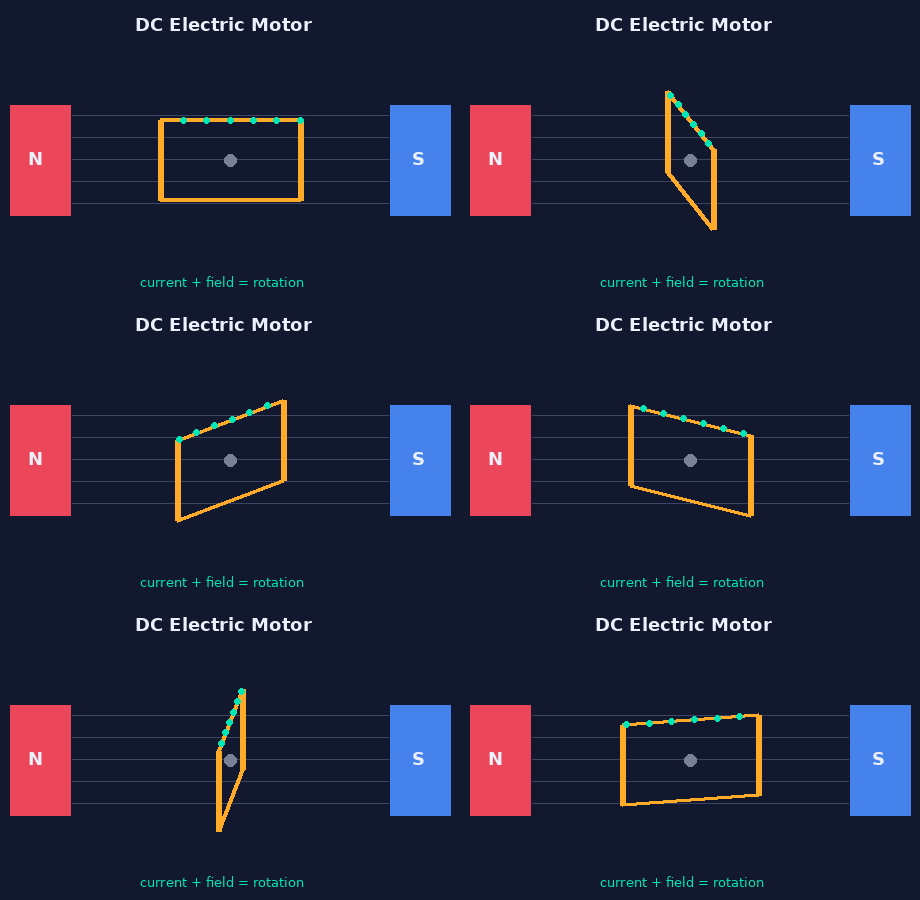
DC electric motor in action: current in a coil placed in a magnetic field turns continuously, the core idea behind every class 12 motor model.
Electromagnetic induction and alternating current19 models
#
Working model
What it demonstrates
Level
1
AC generator dynamo
A rotating coil in a magnet produces alternating voltage.
Medium
2
DC generator
Uses a split ring commutator to deliver one direction output.
Medium
3
Step up step down transformer
Two coils change voltage up or down through a shared core.
Medium
4
Faraday induction coil
A moving magnet through a coil deflects a galvanometer needle.
Easy
5
Lenz law eddy pendulum
A swinging metal plate stops fast due to induced eddy currents.
Medium
6
Wireless power transfer
Lights an LED across an air gap using two coupled coils.
Hard
7
Induction heater model
Heats metal without flame using a high frequency coil field.
Hard
8
Mini Tesla coil
Lights a bulb wirelessly with a high frequency resonant coil.
Hard
9
Mutual inductance demo
Shows how current in one coil induces voltage in a second.
Medium
10
Bicycle dynamo lamp
A wheel driven magnet generator powers a small headlamp.
Easy
11
Coil metal detector
A buzzer sounds when metal upsets the coil oscillation.
Medium
12
Wind turbine generator
Spinning blades turn a magnet rotor to charge a small load.
Medium
13
Hand crank generator
Turning a handle drives a coil to light LEDs by hand.
Easy
14
Hydro generator model
Falling water spins a turbine coupled to a tiny dynamo.
Medium
15
AC induction motor
A rotating field drags a rotor without any electrical contact.
Hard
16
Shake to charge torch
Shaking a magnet through a coil lights an LED torch.
Easy
17
Eddy current tube drop
A magnet falls slowly through a copper pipe.
Easy
18
Three phase model
Shows how three offset coils give smooth rotating power.
Hard
19
Jacob’s ladder model
A rising arc climbs between two diverging electrodes.
Hard
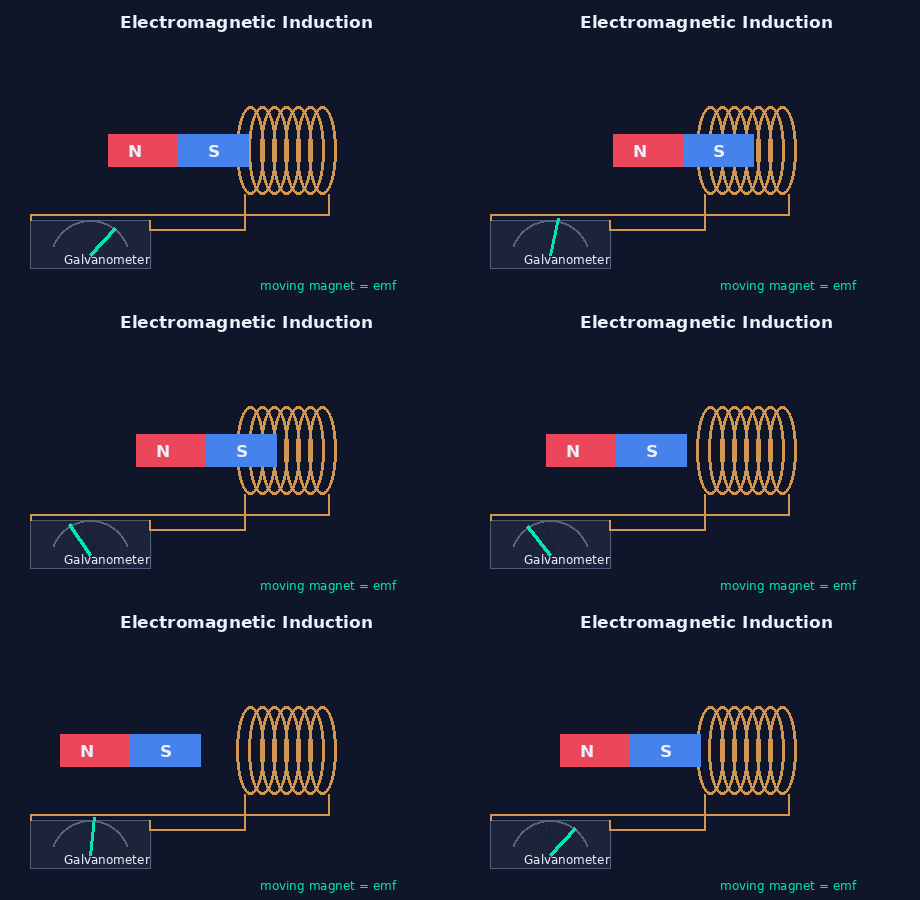
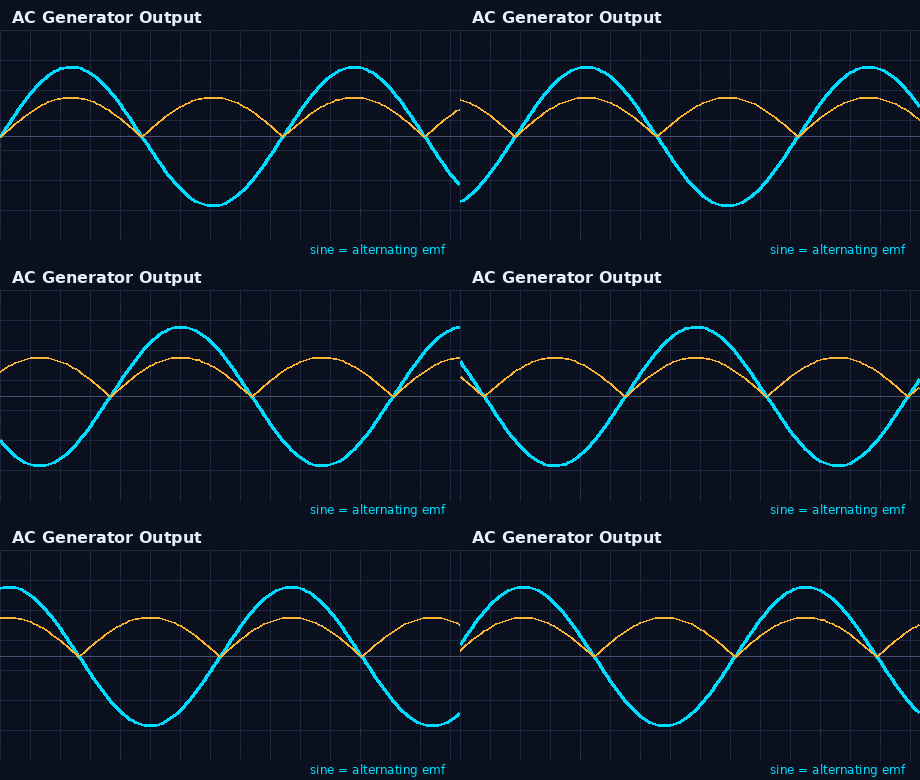
Electromagnetic induction live: a magnet moving through a coil swings the galvanometer needle, showing how relative motion creates an emf.AC generator output: a rotating coil produces a smooth sine wave of alternating voltage, the signature of every alternating current source.
Electromagnetic waves6 models
#
Working model
What it demonstrates
Level
1
EM spectrum chart
A working board links each wave band to a real source.
Easy
2
Infrared remote tester
A camera reveals the invisible infrared pulse from a remote.
Easy
3
Ultraviolet bead detector
Colour changing beads glow under hidden ultraviolet light.
Easy
4
Antenna signal model
A simple antenna picks up and lights an LED from radio waves.
Medium
5
Microwave field demo
Shows standing wave hot spots using a grid of indicators.
Medium
6
Radio wave LED link
Transmits a signal across a gap to flash a receiver LED.
Medium
Ray optics and optical instruments19 models
#
Working model
What it demonstrates
Level
1
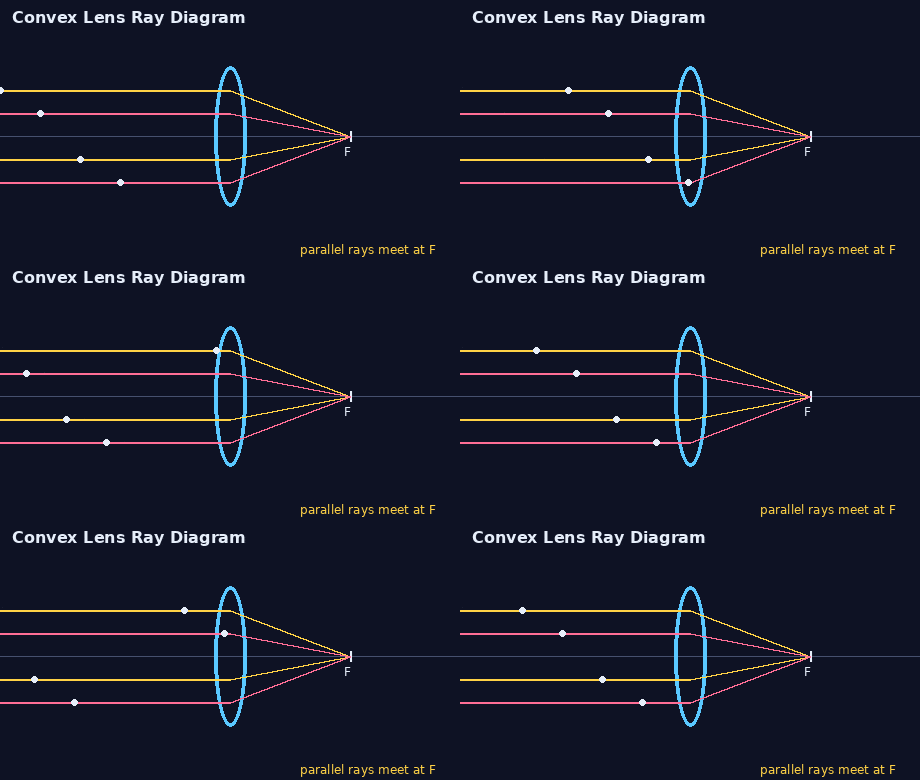
Convex lens imaging
Forms real and magnified images on a screen at the focus.
Easy
2
Concave mirror model
Focuses parallel light rays to a single bright point.
Easy
3
Working periscope
Two angled mirrors let you see over a wall or barrier.
Easy
4
Pinhole camera
A tiny hole projects an inverted image onto a back screen.
Easy
5
Optical fibre light pipe
Guides light around bends by total internal reflection.
Medium
6
Total internal reflection
Shows the critical angle that traps light inside water.
Medium
7
Prism dispersion rainbow
Splits white light into the full spectrum of colours.
Easy
8
Human eye model
A lens and screen mimic focusing, near point and defects.
Medium
9
Refracting telescope
Two lenses bring distant objects close and clear.
Medium
10
Compound microscope
Two lenses magnify a tiny slide many times over.
Medium
11
Newton colour disc
Spinning seven colours blends them back into white.
Bar magnets, neodymium magnets, iron nails, iron filings
Optical
Convex and concave lenses, plane mirrors, prism, laser pointer
Mechanical
Cardboard or plywood base, glue, tape, small DC motor, axle
Measuring
Galvanometer, multimeter, voltmeter, ammeter
Tips to score full marks
Match the model to a chapter you can explain clearly, not just one that looks flashy.
Test the model many times before the exhibition so it never fails in front of judges.
Label every part and keep a one line physics principle ready for each model.
Keep wiring neat and use a fuse or resistor so nothing overheats.
For high voltage models like the Tesla coil, always work with adult supervision.
Frequently asked questions
What is the best physics working model for class 12?
The most reliable class 12 working models are the DC electric motor, the AC generator, the step up and step down transformer, the electromagnetic induction coil and the convex lens imaging setup, because they map directly to the CBSE syllabus and are easy to demonstrate live.
Which class 12 physics models are easy to make at home?
Easy models include the LED resistor circuit, the lemon cell, the battery electromagnet, the simple periscope, the LDR night lamp and the iron filings field map. These need cheap materials and assemble in a single afternoon.
What materials are needed for a class 12 physics working model?
Common materials are insulated copper wire, a small dc motor or magnet, batteries, LEDs, resistors, a breadboard, a galvanometer, magnets, lenses or mirrors, a base board and basic hand tools.
How do I choose a working model for a science exhibition?
Pick a model that matches a chapter you understand, that runs reliably, that is safe to operate in front of judges and that you can explain with the underlying physics principle in one clear sentence.
Are these working models good for the CBSE practical exam?
Yes. Most of these models reinforce the same concepts tested in the class 12 practical syllabus, such as Ohm’s law, electromagnetic induction, rectification and image formation by lenses and mirrors.
Final word
With 131+ ideas across every class 12 chapter, you have more than enough to find a model that fits your interest, your budget and your time. Start with an easy build to gain confidence, then move to a medium or hard model if you want a standout exhibition piece. Whatever you choose, the secret is the same: build it well, test it often and be ready to explain the physics behind it in one clear sentence.
Looking for more ideas? Browse hundreds of additional working models and science fair projects across physics, chemistry and biology on the rest of 1000 Science Fair Projects.