
Updated: November 10, 2026 | Country: South Africa | Sector: Telecommunications Regulation
Quick Answer: What Is Eskom’s Position?
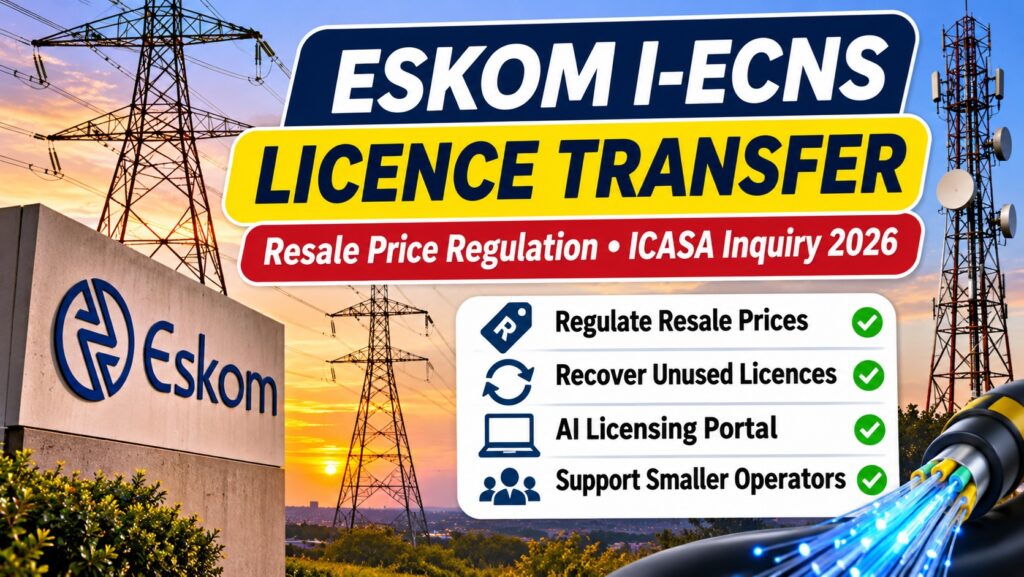
Eskom wants ICASA to regulate the resale prices of Individual Electronic Communications Network Service (I-ECNS) licences to make South Africa’s telecommunications licensing market more accessible and competitive.
The power utility has proposed that unused licences be returned to ICASA, that secondary-market prices be regulated and that an automated digital platform make available licences easier to identify.
Eskom believes expensive licence transfers could obstruct the future commercial use of its communications infrastructure, particularly as the utility undergoes restructuring.
Current status: These are proposals submitted during ICASA’s licensing inquiry, not regulations already in force.
Why Is Eskom Involved in Telecommunications Licensing?
Eskom is best known as South Africa’s state-owned electricity utility. However, the organisation also operates communications infrastructure used to support its electricity network.
That infrastructure can include fibre-optic connections, telecommunications equipment and communications capacity associated with power-system operations.
Eskom’s submission to ICASA explains that the future owner of its communications network could exist outside Eskom Holdings following restructuring.
Even if the network remains within the organisation, Eskom may wish to commercialise spare communications capacity.
The company therefore wants a licensing system that does not impose unnecessary financial or administrative barriers on such activities.
Also Read : Internal Auction Error in WoW Forever
What Is an I-ECNS Licence?
An Individual Electronic Communications Network Service licence, or I-ECNS licence, authorises qualifying operators to provide electronic communications network services within the scope of their licence.
Such licences are important for companies operating telecommunications infrastructure, including certain fibre and wireless network providers.
South Africa’s Electronic Communications Act establishes different licensing categories for network infrastructure and communications services.
| Licence | Purpose | Example |
|---|---|---|
| I-ECNS | Authorises qualifying electronic communications network infrastructure and services. | National-scale network infrastructure operator. |
| I-ECS | Authorises qualifying electronic communications services. | National communications service provider. |
| Class ECNS | Network services within a specified licensing scope or geographic area. | Regional network operator. |
| Class ECS | Communications services under class-licensing conditions. | Regional service provider. |
Depending on the activity, operators may require additional authorisations, including radio-frequency spectrum licences.
Why Are I-ECNS Licence Transfers Expensive?
South Africa has not issued new individual telecommunications licences through a general new licensing round since 2010, according to reporting on the current inquiry.
As a result, companies seeking these licences have often had to acquire them through transfers from existing licence holders.
This creates a secondary market in which licence availability is limited and prices can be substantial.
Easttel, an existing licence holder, told ICASA that acquiring a combined I-ECNS and I-ECS licence package on the secondary market can cost more than R1 million.
That figure is a reported example of secondary-market acquisition costs, not an official fixed price for every licence.
Eskom’s Five Main Proposals for I-ECNS Licensing
1. Regulate Licence Resale Prices
Eskom believes ICASA should consider regulating the value of licences traded in the secondary market.
The objective would be to prevent excessive acquisition costs from becoming a barrier for smaller telecommunications businesses.
Price regulation could potentially reduce the financial advantage enjoyed by businesses that already possess scarce licences.
However, any pricing framework would require careful consideration of market incentives, licence rights and administrative costs.
2. Recover Unused Telecommunications Licences
Eskom proposes that licence holders who are no longer using their licences should return them to ICASA.
It suggested a maximum period of 24 months for unused licences to be surrendered.
The company compared this period with the maximum timeframe generally granted to new licence holders to commence operations before potential revocation.
This proposal is intended to discourage businesses from retaining licences solely for their resale value.
3. Create a Regulated Licence Resale System
Eskom suggested that ICASA could manage a standardised system for making returned licences available to qualifying applicants.
Such a system could improve transparency and potentially reduce uncertainty for new operators.
The exact legal and administrative mechanism has not been finalised.
4. Introduce an AI-Powered Licensing Portal
One of Eskom’s more technologically focused proposals is an automated portal providing current information about available I-ECNS licences.
Such a platform could potentially display:
- Licences available for transfer.
- Relevant licence categories.
- Current application requirements.
- Availability and application status.
- Information useful to prospective applicants.
Eskom specifically suggested using artificial intelligence to collect real-time information about licences available in the secondary market.
This is a proposal, not an existing ICASA AI licensing service.
5. Reduce Barriers for Infrastructure Commercialisation
Eskom wants to ensure that restructuring does not leave its communications infrastructure without a practical route to obtaining the necessary regulatory permissions.
The concern applies whether communications assets remain within Eskom or are transferred to a separate entity.
Lower transaction costs and clearer licensing procedures could make it easier to use surplus network capacity commercially.
Eskom’s Proposals at a Glance
| Proposal | Intended Benefit | Status |
|---|---|---|
| Regulate resale prices | Reduce acquisition costs for smaller operators. | Proposed |
| Return unused licences | Increase the supply of available authorisations. | Proposed |
| 24-month return period | Discourage indefinite retention of unused licences. | Proposed |
| Standardised resale framework | Improve transparency and consistency. | Proposed |
| AI-powered licence portal | Improve access to licence availability information. | Proposed |
What Is ICASA’s Position on New I-ECNS Licences?
ICASA is conducting a formal inquiry into South Africa’s individual electronic communications network licensing framework.
Its objectives include evaluating:
- Whether the existing licence-transfer framework promotes competition.
- Whether additional individual network licences are needed.
- How new licences could affect network coverage.
- Potential improvements in universal access.
- Regulatory, compliance and environmental costs.
On November 2, 2026, ICASA announced the publication of a discussion document representing the second phase of its inquiry.
The document was published in Government Gazette No. 55654, General Notice 4234 of 2026, dated October 30.
ICASA received 33 submissions during the earlier phase of the process.
The regulator is considering stakeholder input before moving to public hearings and final findings.
Why Doesn’t ICASA Simply Issue New Licences?
South Africa’s telecommunications licensing framework places specific procedural requirements on issuing new individual network licences.
Under the Electronic Communications Act, the granting of new I-ECNS licences requires the relevant ministerial policy direction and regulatory application process.
This differs from simply purchasing an existing business or transferring an existing licence.
Communications Minister Solly Malatsi directed ICASA to examine whether new individual network licences should be issued.
The inquiry is therefore examining both the transfer framework and the possible benefits of expanding licence availability.
How Do Other Telecom Operators View Licence Reform?
Eskom is not the only organisation participating in the debate.
ICASA’s inquiry received submissions from established mobile operators, fibre businesses, satellite providers and industry associations.
| Stakeholder | Reported Position or Involvement |
|---|---|
| Eskom | Supports consideration of regulated resale pricing and recovery of unused licences. |
| Internet Service Providers’ Association | Has argued for standing Invitations to Apply for individual licences. |
| Amazon Leo | Warned that secondary-market intervention could introduce administrative complexity. |
| ICASA | Evaluating existing transfers and the need for additional licences. |
| Other operators | Vodacom, MTN, Telkom, Cell C and others submitted views to the inquiry. |
These positions show why the issue is not simply about lowering prices. Regulators must also consider investment incentives, competition, infrastructure development and legal certainty.
Could the Changes Benefit Smaller Internet Providers?
Potentially, yes.
Smaller telecommunications companies may face substantial financial barriers when acquiring individual licences through existing holders.
A more transparent and affordable system could make it easier for qualifying businesses to enter the market.
Possible benefits include:
- Lower licence acquisition costs.
- More opportunities for independent network operators.
- Greater transparency about available licences.
- Reduced dependence on existing licence holders.
- Potential expansion of fibre and other communications infrastructure.
However, lower licence prices alone would not guarantee increased broadband coverage. Operators would still need funding, infrastructure access and viable business models.
Could Eskom Become a Larger Telecommunications Infrastructure Provider?
Eskom’s submission raises an important possibility: its communications infrastructure could support additional commercial telecommunications activity.
If surplus network capacity becomes available under the appropriate licensing arrangements, it could potentially support wholesale connectivity services.
However, Eskom has not announced that the proposed reforms will automatically result in a new national consumer internet service.
Any commercial activity would remain subject to applicable licensing, infrastructure and business requirements.
Latest ICASA I-ECNS Inquiry Timeline
| Date | Development |
|---|---|
| 2025 | Ministerial direction initiates examination of new individual network licensing. |
| Early 2026 | Stakeholders submit responses during the inquiry’s first phase. |
| October 30, 2026 | Discussion document published in Government Gazette No. 55654. |
| November 2, 2026 | ICASA announces publication of the discussion document. |
| November 9, 2026 | Eskom’s licence resale pricing proposals receive renewed public attention. |
| Next phase | Further written representations and public hearings. |
| Final phase | Publication of ICASA’s inquiry findings. |
ICASA invited written representations within 45 working days from the day following publication of the discussion document.
The inquiry is ongoing, and its findings should not be confused with final regulations.
How to Participate in the ICASA Consultation
Interested stakeholders can review the discussion document and prepare written representations supported by relevant evidence.
ICASA identified the following inquiry contact details:
Email: iecns-inquiry@icasa.org.za
Alternative: pmailula@icasa.org.za
Stakeholders should check the official notice for submission requirements and deadlines.
Frequently Asked Questions
What is Eskom’s stance on I-ECNS licence transfers?
Eskom wants ICASA to consider regulating secondary-market licence prices, recovering unused licences and improving transparency through a digital licensing system.
Why does Eskom want licence prices regulated?
Eskom believes expensive secondary-market transactions could create unnecessary barriers for smaller operators and the future commercial use of its communications infrastructure.
What is an I-ECNS licence?
It is an Individual Electronic Communications Network Service licence authorising qualifying telecommunications network activities in South Africa.
How much does an I-ECNS licence cost?
There is no single fixed secondary-market price. One industry participant reported that an I-ECNS and I-ECS licence pair can cost more than R1 million.
Does Eskom want unused licences cancelled?
Eskom proposed that unused licences be returned to ICASA, including a suggested maximum 24-month period for holders who no longer use them.
Has ICASA approved Eskom’s proposal?
No final approval has been established. The proposals form part of an ongoing regulatory inquiry.
Will ICASA issue new I-ECNS licences?
ICASA is examining whether additional licences should be issued. No general new licensing outcome should be assumed before the inquiry and applicable legal processes are completed.
What is Eskom’s AI licensing portal proposal?
Eskom suggested an automated, AI-powered platform that would provide real-time information about licences available in the secondary market.
Could these changes reduce internet prices?
Lower licensing barriers could potentially increase competition, but any effect on consumer prices would depend on market conditions, infrastructure investment and operator behaviour.
When will ICASA make a final decision?
The inquiry is proceeding through consultation, public hearings and final findings. A confirmed final decision date was not established as of November 10, 2026.
Official Sources and References
- ICASA — November 2026 I-ECNS Inquiry Discussion Document
- ICASA — Stakeholder Submissions, Including Eskom
- ICASA — Official Licence Transfer Requirements
- MyBroadband — Eskom’s Licence Resale Pricing Proposal, November 9, 2026
- ITWeb — ICASA’s Review of Dormant Telecoms Licences
More Technology and Telecommunications News
Explore telecommunications regulation, internet infrastructure, technology developments and educational guides at 1000 Science Fair Projects — Technology.
TL;DR: Eskom’s I-ECNS Licence Transfer Position
- Eskom wants ICASA to consider regulating licence resale prices.
- Existing individual licences can be expensive to acquire through transfers.
- Eskom proposes recovering unused licences.
- A maximum 24-month return period has been suggested.
- An AI-powered portal could improve market transparency.
- Other stakeholders disagree on how much regulatory intervention is appropriate.
- ICASA’s inquiry remains ongoing.
- No final policy implementing Eskom’s proposals has been announced.
Bottom line: Eskom supports a more transparent and affordable telecommunications licensing market, particularly to remove barriers for smaller operators and future use of its communications infrastructure. Whether ICASA adopts those recommendations remains undecided.
Editorial note: Updated November 10, 2026. This article draws on ICASA’s public inquiry materials, stakeholder submissions and contemporary reporting. Eskom’s proposals are not presented as existing regulations. The article is independently published and is not affiliated with Eskom or ICASA.


Pingback: IRCTC 500 Exception Error: 8 Ways to Fix It