
Subject: Biology and Environmental Science | Grades: 6–8 | Duration: 7–10 days | Difficulty: Easy to Moderate
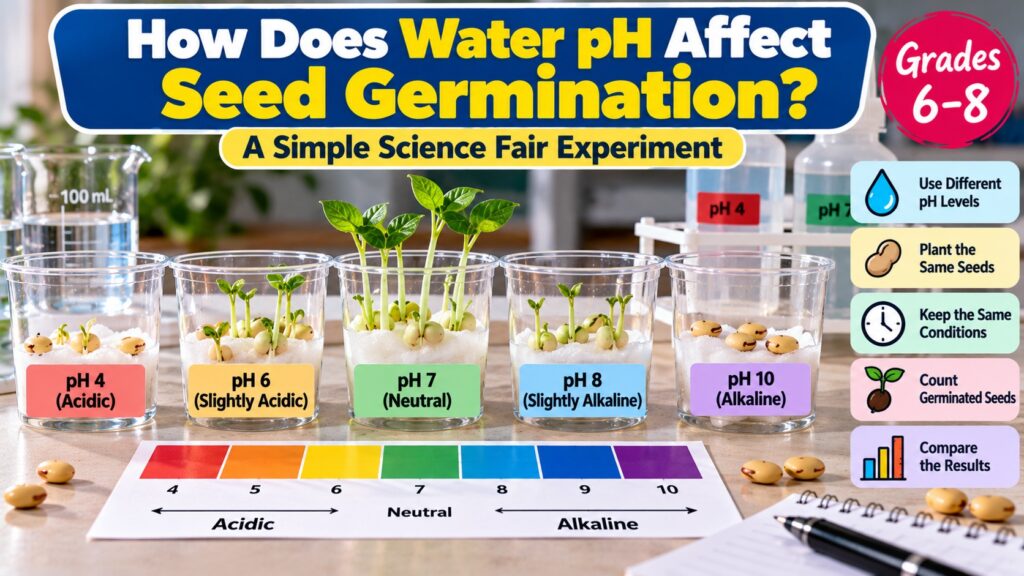
How Does Water pH Affect Seed Germination?
Can the acidity or alkalinity of water change how quickly seeds begin to grow? Water quality is an important environmental factor, and its pH may influence the conditions in which seeds germinate.
In this science fair experiment, students compare radish seeds watered with mildly acidic, near-neutral, and mildly alkaline solutions. They record germination percentages and root growth to investigate whether water pH affects early plant development.
To test this, place equal numbers of radish seeds on identical moist paper towels and treat them with solutions of different measured pH values. Keep temperature, light, moisture, and observation time consistent. Compare germination percentages after seven days.
What Is the Aim of This Experiment?
The aim is to investigate whether water pH affects the germination percentage and early root development of radish seeds.
This experiment introduces students to pH measurement, controlled testing, plant biology, data recording, and environmental science.
Science Fair Research Question
How does watering radish seeds with solutions at approximately pH 5, pH 7, and pH 9 affect germination percentage after seven days?
Hypothesis
This is a prediction, not a guaranteed result. Students should use their own measurements to determine whether the hypothesis is supported.
Materials Required
- 90 radish seeds from the same packet
- Nine identical shallow containers with lids
- Paper towels or filter paper
- Distilled water
- Food-grade white vinegar
- Food-grade baking soda
- pH test strips or a calibrated pH meter
- Three labeled containers for test solutions
- Measuring spoons or pipettes
- Ruler marked in millimeters
- Labels and notebook
- Disposable gloves
- Use only diluted food-grade vinegar and baking soda solutions.
- Do not use drain cleaners, laboratory acids, or concentrated alkaline chemicals.
- Never mix household cleaning products.
- Do not eat seeds or sprouts used in the experiment.
- Wash hands after handling seeds and experimental materials.
- Discard samples if mold develops and avoid inhaling spores.
Understanding the pH Scale
The pH scale describes how acidic or alkaline an aqueous solution is.
| pH Range | General Description | Experiment Group |
|---|---|---|
| Below 7 | Acidic | Approximately pH 5 |
| 7 | Neutral | Near pH 7 |
| Above 7 | Alkaline | Approximately pH 9 |
Actual pH values must be measured rather than assumed from the ingredients.
Variables in the Seed Germination Experiment
| Variable Type | Explanation |
|---|---|
| Independent variable | Measured pH of the treatment solution |
| Dependent variables | Germination percentage and average root length |
| Controlled variables | Seed variety, seed number, container size, paper towel type, temperature, light exposure, moisture, and observation period |
Step-by-Step Water pH and Seed Germination Experiment
Step 1: Prepare the Test Solutions
Prepare three labeled containers of distilled water.
- Acidic treatment: Add small amounts of diluted white vinegar until the measured pH is approximately 5.
- Near-neutral treatment: Use distilled water and measure its actual pH. Aim for approximately pH 7.
- Alkaline treatment: Add very small amounts of baking soda until the measured pH is approximately 9.
Measure each solution using pH test strips or a calibrated pH meter. Record the actual values.
Distilled water can absorb carbon dioxide from the air and may not measure exactly pH 7. Do not assume that a particular ingredient quantity always produces the same pH.
Step 2: Prepare Nine Germination Containers
Line nine identical containers with the same number of layers of paper towel.
Label three containers Acidic 1–3, three Neutral 1–3, and three Alkaline 1–3.
Step 3: Add the Seeds
Place 10 radish seeds in each container, spacing them evenly.
Use seeds from the same packet and avoid visibly damaged seeds.
Step 4: Add the Test Solutions
Add the same measured volume of the appropriate solution to each container, just enough to moisten the paper towel without leaving seeds submerged.
Record the starting volume. Use the same moisture-checking method for all groups throughout the experiment.
Step 5: Maintain Consistent Conditions
Place all containers in the same room at a stable temperature suitable for radish seed germination.
Use loosely fitted lids or ventilated covers to reduce moisture loss while allowing airflow.
Keep light exposure consistent and avoid direct sunlight that could overheat individual containers.
Step 6: Observe Daily
Check the seeds at approximately the same time every day for seven days.
Count a seed as germinated when its first root, called the radicle, is visibly at least 2 mm long.
Record the number of newly germinated seeds and maintain consistent moisture.
Step 7: Measure Root Length
On Day 7, measure the primary root length of each germinated seed in millimeters.
Calculate the average root length for each treatment group using the same measurement method.
Seed Germination Observation Table
Record the cumulative number of germinated seeds out of 30 seeds per treatment.
| Day | Acidic pH 5 | Near-Neutral pH 7 | Alkaline pH 9 |
|---|---|---|---|
| Day 1 | ____ | ____ | ____ |
| Day 2 | ____ | ____ | ____ |
| Day 3 | ____ | ____ | ____ |
| Day 4 | ____ | ____ | ____ |
| Day 5 | ____ | ____ | ____ |
| Day 6 | ____ | ____ | ____ |
| Day 7 | ____ | ____ | ____ |
Final Results Table
| Treatment | Seeds Tested | Seeds Germinated | Germination % | Average Root Length |
|---|---|---|---|---|
| Acidic | 30 | ____ | ____% | ____ mm |
| Near-Neutral | 30 | ____ | ____% | ____ mm |
| Alkaline | 30 | ____ | ____% | ____ mm |
How to Calculate Germination Percentage
For example, if 24 of 30 seeds germinate, the germination percentage is 80%.
This is an illustrative calculation, not an experimental finding.
How to Create a Science Fair Graph
Use a bar graph to compare final germination percentages.
- X-axis: Measured water pH treatment
- Y-axis: Germination percentage
- Title: Effect of Water pH on Radish Seed Germination
You can also create a line graph showing cumulative germination percentage across the seven observation days.
Why Can pH Affect Seed Germination?
Seeds require water, oxygen, and a suitable temperature to germinate. When a seed absorbs water, metabolic processes become active and the embryo begins to grow.
The pH of the surrounding solution can influence chemical conditions near the seed and may affect enzyme activity, nutrient availability, and early root development.
However, the effects vary between plant species and experimental conditions. Mild changes in pH may have little effect on some seeds, while stronger acidity or alkalinity can reduce germination or growth.
Does pH Affect Germination and Root Growth Equally?
Not necessarily. Seeds may germinate successfully but develop shorter or weaker roots under less favorable conditions.
That is why this experiment measures both germination percentage and root length.
Students should not assume that the treatment with the highest germination percentage will also produce the longest roots.
Common Mistakes That Affect Results
| Possible Error | How to Reduce It |
|---|---|
| Assuming pH without testing | Measure and record each solution’s pH |
| Different seed quantities | Use 10 seeds per container |
| Unequal moisture | Apply consistent measured volumes |
| Different temperatures | Keep all containers in the same location |
| Mold contamination | Use clean equipment and monitor samples |
| Inconsistent germination criteria | Count seeds only when the radicle reaches 2 mm |
How to Write the Science Fair Conclusion
How Can Students Extend This Experiment?
- How does water pH affect bean seed germination?
- Does pH affect seedling root length more than germination percentage?
- How does soil pH affect early plant growth?
- Do different seed varieties tolerate acidity differently?
- How does water salinity affect seed germination?
How to Present This Project at a Science Fair
- Research question
- Background research on pH and germination
- Hypothesis
- Independent, dependent, and controlled variables
- Photographs of the experimental setup
- Daily observation table
- Final germination percentage graph
- Root length comparison
- Conclusion and experimental limitations
- Scientific references
More Science Fair Experiments
- Does Light Color Affect Plant Growth?
- Which Type of Soil Holds the Most Water?
- Water Temperature and Sugar Dissolving Experiment
- 100 Science Fair Ideas for 7th Grade
- Science Fair Project Ideas PDF
Educational References
- Science Buddies — Science Fair Project Guide
- University of Minnesota Extension — Plant and Soil Resources
- USGS — Water Science School
Editorial note: This article describes a proposed classroom experiment, not a completed scientific study. Students must record their own observations. Vinegar and baking soda introduce chemical differences beyond pH, which limits conclusions about pH alone.
Key Takeaways
- Water pH may affect germination and early root development.
- Compare acidic, near-neutral, and alkaline treatments.
- Use 30 seeds per treatment across three replicate containers.
- Measure actual pH values instead of assuming them.
- Record germination daily for seven days.
- Use actual measurements and explain experimental limitations.
Suitable for: Grades 6–8 biology, environmental science, and STEM projects in the United States and Canada.