
Updated: November 12, 2026 | Market: United States | Comparison: Seven payroll platforms
Quick Answer: What Is the Best Payroll Software for Startups?
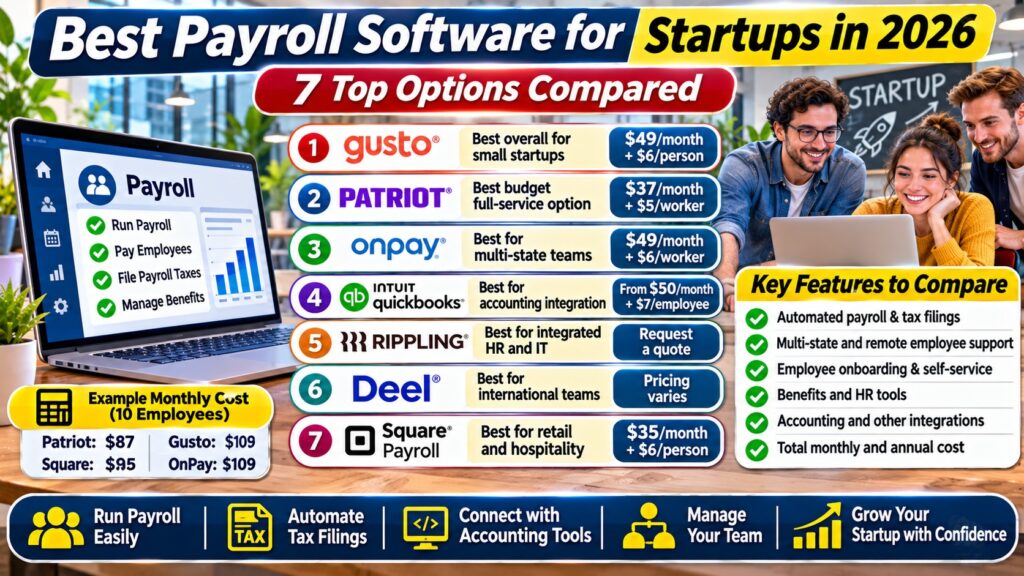
Gusto is our overall recommendation for a small US startup that wants straightforward payroll, automated tax filings and employee onboarding. Its Simple plan starts at $49 per month plus $6 per person.
Patriot Full Service Payroll is a lower-cost alternative at $37 per month plus $5 per worker paid. OnPay is particularly attractive for multi-state startups because its $49 plus $6-per-worker plan includes multi-state payroll.
QuickBooks Workforce is worth considering for businesses already using QuickBooks accounting, while Rippling and Deel may suit more complex HR or international hiring needs.
There is no universally best option: compare tax coverage, workforce location, integrations and total annual cost before choosing.
Best Payroll Software for Startups: 2026 Comparison
| Software | Best For | Starting US Pricing |
|---|---|---|
| Gusto | Overall startup payroll | $49/month + $6/person |
| Patriot Full Service | Low-cost tax-filing payroll | $37/month + $5/worker |
| OnPay | Multi-state startups | $49/month + $6/worker |
| QuickBooks Workforce | Accounting integration | From approximately $50/month + $7/employee for standalone payroll |
| Rippling | Integrated HR, payroll and IT | Request a tailored quote |
| Deel | International teams | Pricing varies by country and service |
| Square Payroll | Retail, restaurants and hourly teams | $35/month + $6/person |
Prices are publicly advertised US list prices reviewed in November 2026, before applicable taxes, add-ons or promotions. QuickBooks package pricing varies when accounting is bundled. Contact Rippling and Deel for a quote matching your workforce.
1. Gusto — Best Overall for Small Startups
Starting price: $49/month + $6/person
Best for: Startups hiring their first W-2 employees.
Official website: Gusto Pricing
Gusto combines payroll processing, tax filings, employee onboarding and selected HR features in a single platform.
Its Simple plan supports unlimited payroll runs, federal and state payroll tax filing, basic paid-time-off policies and employee self-service.
This can be useful for founders who need to run payroll without hiring a dedicated payroll administrator.
Also Read : Lincoln Bragg Error Code
Gusto Pricing in 2026
| Plan | Monthly Base | Per Person |
|---|---|---|
| Simple | $49 | $6 |
| Plus | $80 | $12 |
| Premium | $180 | $22 |
Gusto Simple is aimed at basic payroll in one state. Startups expanding across states should review the Plus plan and applicable registration requirements.
Advantages: Published pricing, automated tax filings, employee onboarding and unlimited payroll runs.
Limitations: More advanced HR features, time tracking and multi-state capabilities may require a higher tier or paid add-ons.
2. Patriot Payroll — Best Budget Full-Service Option
Full Service: $37/month + $5/worker paid
Basic Payroll: $17/month + $4/worker paid
Official website: Patriot Payroll
Patriot is a strong option for startups that prioritize predictable costs over an extensive HR software suite.
Its Full Service plan calculates payroll, deposits payroll taxes and files applicable federal, state and local payroll forms.
The Basic plan costs less but leaves tax deposits and filings to the employer.
That distinction matters: a startup that saves money on software but misses a tax filing deadline may face avoidable penalties.
Patriot Full Service includes filing in one state. Each additional state costs $12 per month.
Advantages: Low published full-service price, unlimited payroll runs, direct deposit and tax filing support.
Limitations: Additional-state fees and fewer bundled advanced HR features than some larger platforms.
3. OnPay — Best for Multi-State Startups
Starting price: $49/month + $6/worker
Official website: OnPay Pricing
OnPay provides full-service payroll for employees and contractors with automatic federal, state and local tax filings.
Its base payroll plan includes multi-state payroll without a separate per-state subscription fee.
This makes it worth comparing with Gusto Plus and Patriot when a startup employs people in several states.
OnPay also provides employee onboarding, benefits administration tools and accounting integrations.
Advantages: Multi-state support, unlimited payroll runs, tax filings and transparent pricing.
Limitations: Advanced HR support, time tracking and some compliance services cost extra.
4. QuickBooks Workforce — Best for QuickBooks Accounting Users
QuickBooks Workforce connects payroll and employee-management features with the QuickBooks financial ecosystem.
This may reduce duplicate data entry for businesses already using QuickBooks Online to manage bookkeeping, expenses and financial reports.
In 2026, QuickBooks expanded its workforce offerings, with payroll, HR and time-management features varying by plan.
Standalone entry-level payroll has been listed around $50 per month plus $7 per employee. Bundled accounting-and-payroll packages can cost substantially more.
Advantages: Connected accounting, payroll reports and familiar Intuit tools.
Limitations: Pricing and included features depend on the selected package, and promotions may obscure the long-term cost.
Official source: QuickBooks Payroll Pricing.
5. Rippling — Best for Integrated HR and IT
Rippling combines payroll with broader employee management, onboarding, access permissions and IT administration.
It may be useful for a technology startup that wants employee records, payroll changes and software access to operate within connected workflows.
For example, an approved employee status change may trigger related HR and payroll updates, subject to the company’s configured workflows.
Advantages: Extensive automation, HR integrations and support for more complex organizations.
Limitations: Pricing is configuration-dependent, and the broader platform may be excessive for a two-person startup.
Official source: Rippling.
6. Deel — Best for International Hiring
Deel focuses on cross-border payroll, contractor payments and international workforce management.
A US startup hiring developers, designers or support staff in other countries may need more than domestic payroll software.
International payroll can involve local employment laws, currency conversion, tax rules and contractor classification.
Deel offers different services for contractors, direct employees and employer-of-record arrangements.
Because pricing depends on the service and countries involved, startups should obtain a quote for their exact hiring structure.
Advantages: International workforce tools and cross-border administration.
Limitations: More expensive services may be unnecessary for a purely domestic startup.
Official source: Deel Pricing.
7. Square Payroll — Best for Retail and Hospitality Startups
Full-service payroll: $35/month + $6/person paid
Contractor-only payroll: $6/person paid monthly, without the full-service base fee
Official website: Square Payroll Pricing
Square Payroll is particularly relevant to small restaurants, retail stores, cafés and other businesses already using Square’s point-of-sale tools.
It can import timecard information and help manage wages, tips and payroll taxes.
Square’s full-service plan includes unlimited payroll runs, tax filings and employee self-service.
Advantages: Competitive pricing and integration with Square’s retail and restaurant tools.
Limitations: Startups outside the Square ecosystem may find other providers better suited to their existing systems.
Payroll Software Cost Comparison: 5, 10 and 25 Employees
The following examples use publicly listed base prices and per-person charges.
Assumptions: all workers are paid during the month, no promotional discounts, one-state payroll where applicable, and no optional add-ons.
| Software / Plan | 5 Workers | 10 Workers | 25 Workers |
|---|---|---|---|
| Patriot Full Service | $62 | $87 | $162 |
| Square Full Service | $65 | $95 | $185 |
| Gusto Simple | $79 | $109 | $199 |
| OnPay Essentials | $79 | $109 | $199 |
| QuickBooks Workforce entry payroll* | $85 | $120 | $225 |
*QuickBooks figures use the reported $50 + $7 standalone entry-level pricing. Confirm the available standalone plan and any required accounting subscription before purchasing.
Example: 10-Person Startup
A startup with 10 employees could pay:
- Patriot Full Service: $87 per month, or $1,044 annually.
- Square Full Service: $95 per month, or $1,140 annually.
- Gusto Simple: $109 per month, or $1,308 annually.
- OnPay Essentials: $109 per month, or $1,308 annually.
These figures cover the payroll subscription, not employee wages, employer payroll taxes, insurance premiums or optional services.
The lowest subscription price does not automatically produce the lowest overall operating cost.
How to Choose Payroll Software for Your Startup
1. Identify Your Workforce Type
Start by separating W-2 employees from legitimate independent contractors.
Worker classification depends on applicable law and the actual working relationship, not simply which tax form a company prefers to issue.
Incorrect classification can lead to tax and employment-law problems.
2. Check Payroll Tax Filing Coverage
Confirm whether the provider calculates, deposits and files payroll taxes at the federal, state and local levels applicable to your company.
Do not assume every low-cost plan includes tax filing.
3. Consider Multi-State Hiring
If you hire remote employees in multiple states, compare state registration requirements, payroll-tax coverage and additional fees.
A provider with a lower monthly base fee may become more expensive as additional states are added.
4. Compare Accounting Integrations
Payroll should fit your bookkeeping process.
Check whether the software can export payroll journals, categorize employer taxes and synchronize with your accounting system.
5. Review Employee Self-Service
Employee portals can reduce administrative work by allowing workers to view pay stubs, update certain personal information and access tax documents.
6. Evaluate Support and Security
Payroll systems contain sensitive financial and identity information.
Look for multi-factor authentication, permission controls, secure document handling and clear support procedures.
7. Calculate the Annual Cost
Compare 12 months of subscription fees, add-ons, implementation charges and state-specific fees.
Promotional discounts should not be treated as permanent savings.
Common Payroll Mistakes Startups Should Avoid
- Choosing the cheapest plan without checking tax-filing coverage.
- Misclassifying employees as contractors.
- Missing state payroll registration requirements.
- Entering incorrect employee banking information.
- Failing to verify payroll before submission.
- Ignoring employer payroll taxes when budgeting.
- Switching providers without transferring year-to-date payroll records.
- Using shared administrator accounts instead of individual secure logins.
Payroll Software vs a Professional Employer Organization
Standalone payroll software generally processes wages and related payroll administration while your startup remains the employer.
A professional employer organization, or PEO, offers a broader co-employment arrangement that may include HR administration, employee benefits and compliance assistance.
PEOs typically cost more than standalone payroll software because the services are broader.
A small startup that only needs to pay five domestic employees may not need a PEO.
A growing business seeking extensive HR and benefits administration may find one worth evaluating.
Frequently Asked Questions
What is the best payroll software for a startup?
Gusto is a strong general-purpose option for small US startups. Patriot is attractive for lower-cost full-service payroll, while OnPay is particularly useful for multi-state teams.
What is the cheapest full-service payroll software?
Among the published plans compared here, Patriot Full Service has the lowest base-plus-worker cost for the example team sizes. Other providers may offer temporary promotions.
How much does payroll software cost for five employees?
Using November 2026 list prices, the five-worker examples range from $62 per month for Patriot Full Service to $85 for the referenced QuickBooks standalone entry plan.
Does payroll software automatically pay taxes?
Full-service payroll plans typically calculate, deposit and file covered payroll taxes. Basic plans may leave filing and payment responsibilities with the employer.
Is Gusto better than QuickBooks Payroll?
Gusto may be simpler for startups prioritizing payroll and onboarding. QuickBooks Workforce may fit businesses that want payroll tightly connected to their existing QuickBooks accounting system.
Is OnPay good for remote startups?
OnPay’s included multi-state payroll makes it a useful option for US startups employing workers in different states.
Can payroll software pay international contractors?
Some providers offer international contractor payments. Confirm country coverage, currency fees, classification requirements and local regulations.
Do startups need payroll software for one employee?
Not necessarily, but software can simplify payroll tax calculations, direct deposits and recordkeeping. Compare the cost against using an accountant or another compliant payroll process.
Can payroll software handle 1099 contractors?
Many platforms support contractor payments and related tax reporting, although the included features and fees vary.
What happens when a startup grows to 25 employees?
Per-worker charges increase subscription costs. Review whether the existing plan still provides suitable HR, reporting, time-tracking and multi-state capabilities.
Official Payroll Software Pricing Sources
- Gusto — Official Pricing
- Patriot — Official Payroll Pricing
- OnPay — Official Pricing
- QuickBooks — Official Payroll Pricing
- Square — Official Payroll Pricing
- Rippling — Official Website
- Deel — Official Pricing
- IRS — Employment Taxes
Related Business and Technology Guides
Read additional software comparisons and technology guides in the 1000 Science Fair Projects Tech section.
Final Verdict: Best Startup Payroll Software in 2026
- Best overall: Gusto.
- Best budget full-service payroll: Patriot.
- Best for multi-state employees: OnPay.
- Best for QuickBooks users: QuickBooks Workforce.
- Best for HR and IT automation: Rippling.
- Best for international teams: Deel.
- Best for retail and restaurants: Square Payroll.
For most US startups with a small domestic workforce, begin by comparing Gusto, Patriot and OnPay. Evaluate the total annual price and tax-filing coverage before making a final decision.
Editorial methodology: This comparison uses publicly available provider pricing, documented features and representative subscription calculations reviewed November 12, 2026. It does not represent hands-on product testing. Rankings are editorial judgments based on common startup needs, not paid placements. Pricing and product terms may change.