
Home » Tech » Computer Vision Projects
👁️ THE COMPLETE 2026 PROJECT LIBRARY
100 Computer Vision Projects
From OpenCV Basics to Generative AI
Hand-picked project ideas with datasets, tools and difficulty levels — covering image classification, object detection, OCR, medical imaging, self-driving perception and image generation.
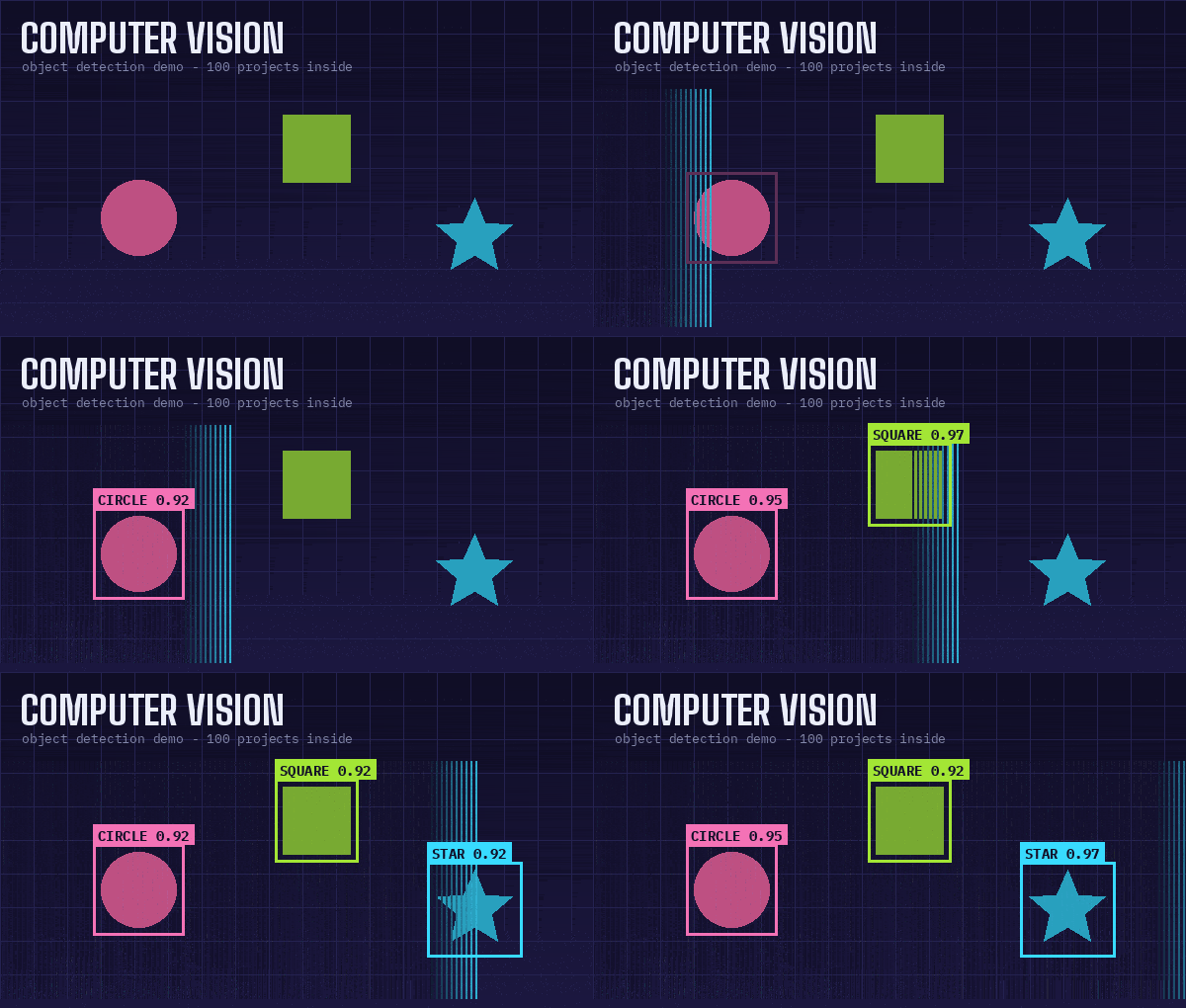
Object detection in action — the skill behind project ideas #21 to #30 below.
⚡ Quick Answer
Computer vision projects teach machines to understand images and video. The best learning path in 2026 is: classical OpenCV projects (edge detection, face detection, document scanning) → CNN classification (cats vs dogs, transfer learning) → detection and tracking (YOLO, DeepSORT) → specialized domains (OCR, medical imaging, self-driving) → generative and multi-modal AI (Stable Diffusion, CLIP, vision-language models). This page lists all 100 ideas with descriptions, tools and datasets.
Computer vision is the most visible branch of AI — literally. When your phone unlocks with your face, when a car brakes for a pedestrian, when a hospital flags a suspicious X-ray, that’s vision code making a judgment in milliseconds. And here’s the good news: every one of those systems started as someone’s first OpenCV script.
We organized these 100 computer vision project ideas into ten career-aligned, color-coded categories. Start with the green beginner zone — no GPU required — then follow your interests into detection, medical AI, autonomous driving or generative imagery. Each idea tells you what you will build and exactly what it teaches.
Also Read : Modrinth “Too Many API Errors; Temporarily Blocked”
📚 What’s Inside: All 10 Categories at a Glance
| Category | Projects | Level | Key Tools |
|---|---|---|---|
| 🌱 Beginner Computer Vision Projects | 1–10 | Beginner | OpenCV, NumPy |
| 🖼️ Image Classification Projects | 11–20 | Beginner+ | CNNs, Transfer Learning, ViT |
| 🎯 Object Detection & Tracking Projects | 21–30 | Intermediate | YOLO, DeepSORT, MediaPipe |
| 🙂 Face Analysis & Recognition Projects | 31–40 | Intermediate | face_recognition, MediaPipe |
| 📄 OCR & Document Analysis Projects | 41–50 | Intermediate | Tesseract, EasyOCR, LayoutLM |
| 🩺 Medical & Scientific Imaging Projects | 51–60 | Advanced | U-Net, Grad-CAM, PyTorch |
| 🌾 Agriculture & Environment Projects | 61–70 | Intermediate | CNNs, Drone & Satellite Data |
| 🚗 Autonomous Vehicles & Robotics Projects | 71–80 | Advanced | Segmentation, Depth, SLAM |
| 🎨 Generative AI & Image Synthesis Projects | 81–90 | Advanced | GANs, Stable Diffusion, LoRA |
| 🚀 Advanced & Real-Time Vision Systems | 91–100 | Expert | CLIP, NeRF, ONNX, MLOps |
Tap any category to jump straight to its project list.
🌱 1. Beginner Computer Vision Projects (Projects 1–10)
1Handwritten Digit Recognition (MNIST)
The ‘Hello World’ of computer vision – train a simple convolutional neural network to read handwritten digits with 99% accuracy. You will learn image tensors, convolutions, and the full training loop in TensorFlow or PyTorch.
2Image Color Detector
Build a tool that identifies the dominant colors in any photo using K-Means clustering on pixel values. A gentle introduction to treating images as data with OpenCV and NumPy.
3Edge Detection Playground
Apply Canny, Sobel, and Laplacian edge detectors to your own photos and compare results side by side. Understand gradients and filters – the mathematical heart of classical vision.
4Pencil Sketch & Cartoon Filter App
Convert photos into pencil sketches and cartoon-style art using Gaussian blurring, bilateral filtering, and edge masks. Instant visual gratification while learning image transformations.
5Face Detection with Haar Cascades
Detect faces in photos and webcam feeds with OpenCV’s classic Haar cascade classifiers. The perfect first step before modern deep learning detectors.
6QR Code and Barcode Scanner
Build a scanner that reads QR codes and barcodes from images or live camera input using OpenCV and pyzbar. A practical project you will actually use.
7Image Stitching Panorama Maker
Stitch overlapping photos into a seamless panorama using feature matching with SIFT/ORB and homography transforms. Learn how your phone’s panorama mode really works.
8Motion Detection Security Camera
Turn a webcam into a motion-triggered security camera using frame differencing and contour detection. Save snapshots whenever movement is detected.
9Green Screen Background Replacement
Implement chroma keying that swaps a green background for any image using HSV color masking. The foundation of every video call background filter.
10Document Photo Scanner
Detect a document’s edges in a photo, correct the perspective, and output a clean scanned-look image. A mini CamScanner built with contour detection and warp transforms.
🖼️ 2. Image Classification Projects (Projects 11–20)
11Cats vs Dogs Classifier
The classic binary classification challenge – train a CNN to distinguish cats from dogs on 25,000 images. Learn data augmentation, dropout, and how to fight overfitting.
12CIFAR-10 Object Classification
Classify tiny 32×32 images into ten everyday categories like planes, ships, and trucks. A standard benchmark that teaches you to squeeze accuracy from limited resolution.
13Transfer Learning with Pretrained Models
Fine-tune ResNet, EfficientNet, or MobileNet on your own small dataset and watch accuracy jump with minimal training. The single most practical skill in applied vision.
14Food-101 Dish Recognition
Identify 101 food dishes from photographs – from samosas to sushi. A deliciously challenging dataset with real-world lighting and plating variety.
15Flower Species Classifier
Classify 102 flower species from the Oxford Flowers dataset using fine-tuned CNNs. Beautiful data and a genuine fine-grained classification challenge.
16Garbage Classification for Recycling
Sort waste images into glass, plastic, metal, paper, and organic categories. An environmental AI project with obvious smart-city applications.
17Fashion Product Categorization
Classify clothing images into categories and attributes using the Fashion-MNIST and DeepFashion datasets. The technology behind visual search in e-commerce.
18Indian Currency Note Recognition
Recognize rupee note denominations from photos – a genuinely useful accessibility tool for visually impaired users when paired with text-to-speech.
19Sports Action Classification
Classify images of cricket shots, football kicks, or yoga poses into action categories. Combine pose estimation features with CNN classifiers for higher accuracy.
20Vision Transformer (ViT) vs CNN Showdown
Train a Vision Transformer and a CNN on the same dataset and benchmark accuracy, speed, and data hunger. Understand why transformers are taking over vision.
🎯 3. Object Detection & Tracking Projects (Projects 21–30)
21Real-Time Object Detection with YOLO
Run YOLOv8/YOLOv9 to detect and label people, cars, and animals in live video at 30+ FPS. Learn bounding boxes, confidence thresholds, and non-max suppression.
22Custom Object Detector for Your Own Dataset
Label your own images with Roboflow or LabelImg and train YOLO to detect anything – your pet, a product, a logo. The complete custom detection pipeline.
23Vehicle Counting on Highway Footage
Count cars, buses, and trucks crossing a virtual line in traffic videos using detection plus centroid tracking. Real transportation analytics in action.
24Multi-Object Tracking with DeepSORT
Track multiple people across video frames with persistent IDs by combining YOLO detection and DeepSORT appearance embeddings. The backbone of retail and security analytics.
25Helmet Detection for Road Safety
Detect whether two-wheeler riders are wearing helmets in traffic footage. A high-impact project aligned with road safety enforcement in India.
26Social Distancing Monitor
Measure distances between detected people in CCTV-style video and flag violations using camera calibration and bird’s-eye-view transforms.
27Wildlife Camera Trap Analyzer
Automatically identify animal species in camera-trap images to support conservation research. Handle night-vision images, motion blur, and severe class imbalance.
28Drone-View Object Detection
Detect tiny objects – people, vehicles, boats – in aerial drone imagery using the VisDrone dataset. Learn why small-object detection needs special techniques.
29Hand Tracking and Gesture Control
Track 21 hand landmarks in real time with MediaPipe and control your computer’s volume or slides with gestures. Instant futuristic demo material.
30Ball Tracking for Sports Analytics
Track a cricket or tennis ball across video frames, plot its trajectory, and estimate speed. The DIY version of broadcast Hawk-Eye graphics.
🙂 4. Face Analysis & Recognition Projects (Projects 31–40)
31Face Recognition Attendance System
Build an attendance logger that recognizes registered faces from a webcam and records entries with timestamps using the face_recognition library and OpenCV.
32Facial Emotion Detection
Classify faces into emotions – happy, sad, angry, surprised – using CNNs trained on the FER-2013 dataset. Discuss honestly where emotion AI works and where it fails.
33Age and Gender Estimation
Predict approximate age range and gender from face images using pretrained deep models. A study in model bias and responsible reporting of uncertain predictions.
34Drowsiness Detection for Drivers
Monitor eye aspect ratio and head pose through a dashcam-style feed and sound an alarm when a driver’s eyes stay closed too long. Vision AI that can save lives.
35Face Mask Detection
Detect whether people are wearing masks using transfer learning with MobileNet. A pandemic-era classic that still teaches real-time classification deployment.
36Virtual Makeup and Filter App
Apply lipstick, sunglasses, or fun filters that track facial landmarks in real time – the Snapchat effect built with MediaPipe Face Mesh’s 468 landmarks.
37Face Blurring for Privacy Protection
Automatically detect and blur all faces in photos and videos – the privacy tool every news organization and dashcam company needs.
38Smile-Triggered Selfie Camera
Capture a photo automatically when everyone in frame is smiling, using facial landmark geometry. A delightful beginner-friendly face project.
39Head Pose Estimation
Estimate where a person is looking by computing head yaw, pitch, and roll from facial landmarks. Used in driver monitoring and attention analytics.
40Deepfake Detection Basics
Train a classifier to spot AI-generated face images using artifacts in frequency space and facial inconsistencies. Join the defense side of the deepfake arms race.
📄 5. OCR & Document Analysis Projects (Projects 41–50)
41Receipt Scanner and Expense Tracker
Extract merchant, date, and total from receipt photos with Tesseract or EasyOCR, then log expenses to a spreadsheet automatically. Practical OCR with instant personal value.
42License Plate Recognition (ANPR)
Detect vehicle number plates and read their text by chaining object detection with OCR. Mirrors real automatic number plate recognition systems used in parking and tolling.
43Handwriting Recognition
Go beyond digits – recognize full handwritten words and sentences using CRNN or TrOCR transformer models on the IAM handwriting dataset.
44Invoice Data Extraction Pipeline
Pull structured fields – invoice number, GST, line items, totals – from PDF invoices into JSON using layout-aware models like LayoutLM. High-value business automation.
45Math Equation Solver from Photos
Recognize a handwritten or printed equation from a photo and solve it with SymPy. The Photomath concept, built end to end.
46Multi-Language Sign Board Reader
Detect and read text from street signs in multiple Indian languages and scripts, then translate it. Combines scene-text detection (EAST/CRAFT) with OCR and translation APIs.
47Old Document Digitization & Restoration
Clean noisy scans of old books with binarization and denoising, then OCR them into searchable text. Cultural preservation meets image processing.
48Table Extraction from Documents
Detect tables in scanned reports and reconstruct them as CSV files, preserving rows and columns. One of the hardest and most requested document AI tasks.
49Business Card Reader App
Extract names, phone numbers, and emails from business card photos straight into a contacts file using OCR plus regex and NER post-processing.
50Answer Sheet / OMR Evaluator
Automatically grade multiple-choice OMR sheets from photos using circle detection and thresholding. Every coaching institute wants exactly this tool.
🩺 6. Medical & Scientific Imaging Projects (Projects 51–60)
51Pneumonia Detection from Chest X-Rays
Train a CNN to detect pneumonia in chest radiographs and visualize its reasoning with Grad-CAM heatmaps. The canonical introduction to responsible medical imaging AI.
52Skin Lesion Classification
Classify dermatoscopic images into lesion types using the HAM10000 dataset. Learn about class imbalance, calibration, and why dermatology AI needs careful validation.
53Brain Tumor Segmentation from MRI
Segment tumor regions in MRI scans with a U-Net architecture. Pixel-level prediction – one of the most respected skills in medical vision.
54Blood Cell Counting and Classification
Count and classify red cells, white cells, and platelets in microscope images. Automating one of pathology’s most repetitive tasks.
55Diabetic Retinopathy Grading
Grade retinal fundus images by disease severity using the APTOS dataset. A Kaggle-famous challenge with massive screening impact in India.
56Malaria Parasite Detection in Cell Images
Detect malaria-infected cells in thin blood smear images with a lightweight CNN that could run on a low-cost field microscope.
57Bone Fracture Detection in X-Rays
Detect and localize fractures in musculoskeletal X-rays using the MURA dataset. Learn how radiologist-AI collaboration is actually evaluated.
58COVID-19 CT Scan Analysis
Classify and segment lung abnormalities in CT slices – and study the published pitfalls of pandemic-era models as a masterclass in dataset bias.
59Microscopy Cell Segmentation
Segment individual cells in crowded microscopy images using Cellpose or StarDist. A workhorse task across all of biological research.
60Plant Cell vs Animal Cell Classifier
A science-fair friendly project classifying microscope slide images of plant and animal cells, with clear visual explanations of what features the model uses.
🌾 7. Agriculture & Environment Projects (Projects 61–70)
61Plant Disease Detection from Leaf Images
Classify crop diseases from leaf photos using the PlantVillage dataset – hugely relevant for Indian agritech, deployable as a farmer-facing mobile app.
62Weed vs Crop Detection for Smart Farming
Detect weeds among crop rows in field images to enable targeted spraying. Precision agriculture that cuts herbicide use dramatically.
63Fruit Ripeness Grading
Grade tomatoes, bananas, or mangoes by ripeness from color and texture features. Straightforward, visual, and directly useful in supply chains.
64Crop Yield Estimation from Drone Imagery
Count plants and estimate yield from aerial farm images using detection and density-map regression. Agritech startups are built on exactly this capability.
65Satellite Image Land Cover Classification
Classify satellite tiles into forest, water, urban, and farmland using EuroSAT data. Your gateway into remote sensing and geospatial deep learning.
66Deforestation Change Detection
Compare satellite images across years to automatically flag deforestation zones. Environmental monitoring with before/after change-detection networks.
67Cattle and Livestock Counting
Count and monitor livestock in drone or CCTV footage of farms and pastures. Animal detection with occlusion challenges that sharpen real skills.
68Fish Species Identification
Identify fish species from photos for fisheries monitoring and biodiversity studies – useful from aquariums to research vessels.
69Forest Fire and Smoke Detection
Detect smoke plumes and fire in camera and satellite imagery for early-warning systems. Latency and false-alarm trade-offs make this a serious engineering exercise.
70Soil Type Classification from Images
Classify soil types from close-up photographs using texture analysis and CNNs, helping farmers pick suitable crops without lab testing.
🚗 8. Autonomous Vehicles & Robotics Projects (Projects 71–80)
71Lane Detection for Self-Driving Cars
Detect lane lines in dashcam video using Hough transforms, then upgrade to deep segmentation models. The classic first step into autonomous driving.
72Traffic Sign Recognition
Classify 43 categories of road signs from the German GTSRB benchmark – a core perception module in every driver-assistance system.
73Traffic Light State Detection
Detect traffic lights and classify their state (red/yellow/green) in street scenes. Small objects, high stakes, real-world messiness.
74Pedestrian Detection and Intent Estimation
Detect pedestrians and estimate whether they are about to cross using pose cues. The hardest, most safety-critical perception problem on the road.
75Monocular Depth Estimation
Predict a depth map from a single camera image using models like MiDaS. Understand how 2D pixels become 3D understanding without LiDAR.
76Road Pothole Detection
Detect potholes in dashcam footage and map them with GPS – a civic-tech project with obvious value for Indian municipal authorities.
77Semantic Segmentation of Street Scenes
Label every pixel of driving scenes as road, vehicle, person, or building using DeepLab or SegFormer on the Cityscapes dataset.
78Visual Odometry from Camera Motion
Estimate a vehicle’s trajectory purely from camera frames using feature tracking and pose estimation. The vision half of SLAM.
79Line-Following Robot with a Camera
Build a Raspberry Pi robot that follows a track using camera input instead of IR sensors. Embedded vision and control on a student budget.
80Parking Space Occupancy Detection
Detect free and occupied parking slots from an overhead camera feed – a smart-city project deployable with one cheap camera per lot.
🎨 9. Generative AI & Image Synthesis Projects (Projects 81–90)
81Photo Colorization of Black & White Images
Bring old family photos to life with pretrained colorization networks – visually stunning results that make portfolios memorable.
82Neural Style Transfer Art Generator
Repaint your photos in the style of famous art movements by optimizing content and style losses. The project that made deep learning visually famous.
83GAN for Face Generation
Train a DCGAN or StyleGAN to generate realistic faces and explore latent-space arithmetic. Study mode collapse and training instability firsthand.
84Image Super-Resolution Enhancer
Upscale low-resolution images 4x with ESRGAN or SwinIR, restoring crisp detail. The ‘enhance’ button from crime dramas, actually built.
85Stable Diffusion Fine-Tuning with LoRA
Fine-tune a diffusion model on your own art style or product photos using LoRA adapters. The hottest generative-vision skill of 2026.
86AI Image Inpainting Object Remover
Erase unwanted objects or people from photos and let a diffusion model fill the gap convincingly. The magic-eraser feature, demystified.
87Text-to-Image Prompt Engineering Lab
Systematically study how prompt wording, negative prompts, and guidance scales change diffusion outputs, and document your findings like a scientist.
88Image-to-Image Sketch to Photo Translation
Translate sketches into photorealistic images with Pix2Pix or ControlNet. Conditional generation that designers genuinely use.
89Old Photo Restoration Pipeline
Combine scratch removal, denoising, face enhancement, and colorization into one restoration pipeline for damaged vintage photographs.
90AI-Generated Image Detector
Train a classifier to distinguish real photos from diffusion-generated images – the counterpart to generative AI that newsrooms and platforms urgently need.
🚀 10. Advanced & Real-Time Vision Systems (Projects 91–100)
91Real-Time Pose Estimation Fitness Coach
Count squats and push-ups and correct posture in real time using MediaPipe or MoveNet pose landmarks. A complete AI fitness product in one project.
92Visual Question Answering System
Build a system that answers natural-language questions about images using vision-language models like BLIP or LLaVA. Where vision meets LLMs.
93CLIP-Powered Semantic Image Search
Search your photo library with text queries like ‘sunset over water’ using CLIP embeddings and a vector database. Multi-modal retrieval done right.
94Image Captioning with Transformers
Generate natural-language captions for photos by pairing a vision encoder with a language decoder – a showcase bridge between two AI worlds.
953D Reconstruction with NeRF / Gaussian Splatting
Turn a set of phone photos into an explorable 3D scene using Neural Radiance Fields or 3D Gaussian Splatting – the frontier of 3D vision.
96Edge AI Vision on Raspberry Pi
Deploy quantized detection models on a Raspberry Pi or Jetson Nano and measure FPS, power, and accuracy trade-offs. Real-world deployment engineering.
97Video Action Recognition
Classify human actions – cooking, dancing, cricket batting – in video clips using 3D CNNs or video transformers on the Kinetics dataset.
98Anomaly Detection for Factory Quality Control
Spot defective products on a production line using autoencoder reconstruction error on the MVTec dataset. Industrial vision is a billion-dollar quiet market.
99Crowd Counting and Density Estimation
Estimate crowd sizes in dense gatherings using density-map regression networks – vital for event safety and urban planning.
100End-to-End Vision Model Deployment with MLOps
Take a vision model from notebook to production API with ONNX export, Docker, monitoring, and drift detection. The capstone that proves you can ship.
Save this guide — 100 projects, ten specializations, one roadmap.
🎯 How to Choose Your First Project
| Your Goal | Start With | Time Needed |
|---|---|---|
| Learn the basics (no GPU) | Edge Detection, Face Detection, Document Scanner (#1–#10) | 2–5 days each |
| Get a job interview | Custom YOLO Detector, Pose Fitness Coach, OCR Pipeline (#21–#60) | 2–4 weeks each |
| Work with modern generative AI | Stable Diffusion LoRA, CLIP Search, NeRF 3D (#81–#100) | 3–8 weeks |
| Science fair entry | Plant Disease Detection, Cell Classifier, Fruit Ripeness Grading | 2–3 weeks |
💡 Frequently Asked Questions
❓ What are good computer vision projects for beginners?
Good beginner computer vision projects include handwritten digit recognition (MNIST), face detection with Haar cascades, QR code scanners, edge detection experiments, motion-detection security cameras, and document photo scanners. These need only Python, OpenCV, and a webcam, and teach core concepts like filters, contours, and image transforms before deep learning.
❓ Which computer vision projects are best for a resume in 2026?
The strongest resume projects in 2026 are custom YOLO object detectors trained on your own labeled dataset, CLIP-powered semantic image search, real-time pose estimation apps, Stable Diffusion LoRA fine-tuning, edge deployment on Raspberry Pi, and end-to-end MLOps deployment of a vision model. Recruiters value deployed, documented systems over notebook experiments.
❓ What tools and libraries are used for computer vision projects?
Core tools are Python, OpenCV, NumPy, and PyTorch or TensorFlow. Object detection uses YOLO (Ultralytics) and Roboflow for labeling; pose and face tasks use MediaPipe; OCR uses Tesseract, EasyOCR, and TrOCR; generative projects use Stable Diffusion and ControlNet; deployment uses ONNX, Docker, and Jetson or Raspberry Pi hardware.
❓ Do I need a GPU for computer vision projects?
Not at the start. Classical OpenCV projects and small CNNs run fine on a laptop CPU. For deep learning training, free GPU access from Google Colab or Kaggle Notebooks is enough for most projects on this list. A dedicated GPU only becomes important for training large models, video workloads, or diffusion fine-tuning.
❓ Where can I find free datasets for computer vision projects?
Free computer vision datasets are available on Kaggle, Roboflow Universe, Hugging Face Datasets, Google Open Images, COCO, ImageNet, PlantVillage for agriculture, MURA and HAM10000 for medical imaging, Cityscapes and VisDrone for driving and aerial scenes, and EuroSAT for satellite imagery.
❓ Can computer vision projects be used for science fairs?
Yes. Computer vision projects like plant disease detection, plant vs animal cell classification, motion-detecting security cameras, fruit ripeness grading, and pothole detection make excellent science fair projects because they combine a clear hypothesis, real image data, measurable accuracy results, and a working demo judges can try.
Teach a Machine to See 👁️
Pick one project from the green beginner zone, point your webcam at the world, and ship something this week. One working demo beats a hundred bookmarked tutorials — every single time.
Related guides: 100 Data Science Projects • Tech Projects Hub • 1000 Science Fair Projects Home

Pingback: 100 Data Science Projects With Source Ideas (2026 Guide)
Hey very nice site!! Man .. Excellent .. Wonderful ..
I’ll bookmark your site and take the feeds also? I’m satisfied to search out
so many useful info here in the put up, we want develop more
strategies in this regard, thanks for sharing. . . .
. .
Hi all, here every person is sharing such experience, so it’s
pleasant to read this webpage, and I used to pay a quick
visit this webpage every day.
Great post.
It’s very effortless to find out any matter on net as compared
to books, as I found this piece of writing
at this website.
Hey! I understand this is sort of off-topic but I needed to ask.
Does operating a well-established blog like yours take
a lot of work? I am completely new to running a blog but I do write in my diary on a
daily basis. I’d like to start a blog so I can share my personal experience and views online.
Please let me know if you have any suggestions or tips for brand
new aspiring bloggers. Appreciate it!
It’s amazing for me to have a web page, which is good in support of
my knowledge. thanks admin
bookmarked!!, I love your blog!
Have you eve considered publishing an ebook oor guest authoring onn
other sites? I have a blog centered on the same ideas you discuss and would love to have yoou share some stories/information. I knoww my visitors wopuld appreciate
your work. If you’re even remotely interested, feel free to send me an email.
My site; sıra bulucu