
Quick answer
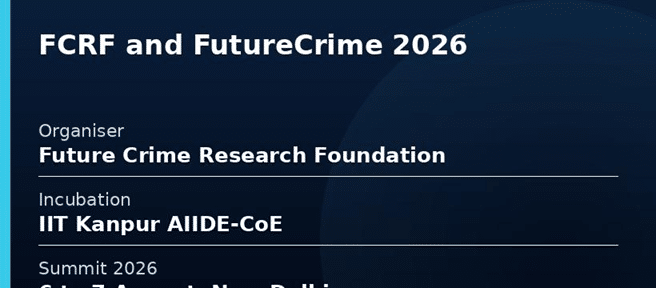
The FCRF Hackathon is a cyber and digital forensics competition run by the Future Crime Research Foundation, an IIT Kanpur incubated non profit, alongside its annual FutureCrime Summit. The 2025 edition ran a large digital forensics hackathon using a cyber range platform. The FutureCrime Summit 2026 is scheduled for 6 to 7 August 2026 in New Delhi, and hackathon details for 2026 are usually shared after registration opens. Watch the official FCRF channels for the exact dates.
On this page
What is the FCRF Hackathon
The FCRF Hackathon is a competitive event focused on digital forensics and cyber crime investigation. Participants work through realistic problem statements that simulate cyber incidents, such as attacks on financial systems or critical infrastructure, and apply forensic skills to investigate them. The 2025 edition was promoted as one of the largest digital forensics hackathons, built on a cyber range platform that recreates real world scenarios.
It is not a typical app building hackathon. The challenges lean towards incident response, evidence analysis and threat investigation, which makes it a strong fit for students and professionals interested in cyber security careers.
Who is FCRF
The Future Crime Research Foundation is a non profit incubated at IIT Kanpur through the AIIDE Centre of Excellence. It works across cyber security, digital crime, fraud risk management, cyber law, cyber forensics and policy research, and collaborates with government bodies, law enforcement, academia and industry.
FutureCrime Summit 2026 and the hackathon
The hackathon usually runs in the wider ecosystem of the FutureCrime Summit. The FutureCrime Summit 2026 is being held on 6 to 7 August 2026 in New Delhi, described by the organisers as India’s largest conference on cyber crime, digital forensics, cyber law and AI driven threats. Past editions have drawn well over a thousand delegates and dozens of expert speakers.
What to expect and the cyber range
Unlike a build a product hackathon, the FCRF format centres on investigation. Teams receive problem statements that mimic real incidents and then work to find out what happened, how, and what evidence proves it. In the 2025 edition, challenges were curated on a cyber range, a controlled environment that recreates real systems and attacks so participants can practise safely without touching live infrastructure.
A typical flow involves analysing disk and memory images, reading logs and network captures, reconstructing a timeline of the attack, and writing up findings clearly. Communication matters as much as technical skill, because a forensic conclusion is only useful if it can be explained and defended. Expect time pressure, teamwork, and a steep but rewarding learning curve.
The wider summit adds value beyond the contest itself. The FutureCrime Summit has featured senior voices from national cyber agencies, law enforcement and industry, and past editions have drawn large delegate numbers across more than fifty organisations. For a student, being in that room is a networking opportunity as much as a competition.
Who can join and how
Based on previous editions, the event welcomes a broad mix of participants.
Registration is typically done through an online form on the official site, after which participants receive problem statements and updates by email. Keep an eye on the FCRF website for the live registration link for the 2026 cycle.
How to prepare
If you want to compete well, build the fundamentals first.
Strong problem solving habits help across every technical contest. If you enjoy reasoning under pressure, our inorganic chemistry exceptions quiz is a fun way to keep that edge sharp between practice sessions. For more learning resources, visit the 1000 Science Fair Projects home page.
A practical way to prepare is to play through past style challenges in a home lab. Set up a couple of virtual machines, capture some traffic, intentionally create and then recover a few deleted files, and practise writing a short report on what you found. Free capture the flag platforms and beginner forensic exercises mirror the kind of thinking the hackathon rewards. Above all, work on explaining your reasoning simply, because clear communication is what makes a good investigator stand out from a merely technical one.
Keep reading

Pingback: Inorganic Chemistry Exceptions Quiz for JEE Main - Technical Help, Support and Guidance